

In 2026, the cloud and AI infrastructure sector is experiencing rapid growth, driven by key players like Microsoft, Nvidia, and Amazon, alongside specialized providers such as CoreWeave and Nebius. The market is characterized by significant capital expenditures and strategic partnerships aimed at building out the foundational technologies for AI and cloud computing.
Microsoft, Nvidia, and Amazon are consistently identified as leading cloud and AI infrastructure stocks for 2026, backed by strong analyst ratings and substantial revenue growth. Nvidia is considered the most direct investment in AI data center demand, with fiscal 2026 revenue jumping 65% to $215.9 billion. Specialized AI cloud providers like CoreWeave and Nebius are securing massive contracts, demonstrating high growth rates and significant demand for dedicated AI compute capacity. Major hyperscalers, including Amazon and Alphabet, are making substantial investments, with Amazon committing an additional $25 billion to Anthropic and Alphabet planning $175 billion to $185 billion in capital expenditures for 2026. Subscription revenue models are strong in the cloud sector; for example, one company projects subscription revenue to reach $15.6 billion in fiscal 2026, growing 21% year over year. Beyond the hyperscalers, companies like Broadcom, Arista Networks, and Calix are also positioned for growth due to their roles in essential infrastructure or AI-driven solutions. The market is seeing a clear trend of specialized AI cloud demand outrunning supply, evidenced by large backlogs and significant financing rounds for pure-play AI infrastructure companies.
The best cloud and AI infrastructure stocks for 2026 include Microsoft (MSFT), Nvidia (NVDA), and Amazon (AMZN) for their balanced exposure, direct AI data center play, and cloud leadership, respectively. Specialized providers like CoreWeave and Nebius also offer high growth potential for investors comfortable with higher risk. Essential infrastructure support companies such as Broadcom (AVGO) and Arista Networks (ANET) are critical for the broader buildout.
Overview of Cloud and AI Infrastructure in 2026
The convergence of cloud computing and artificial intelligence has created the most dynamic investment theme of the decade. Infrastructure forms the bedrock of this transformation—without the servers, networks, and specialized hardware, none of the advanced AI applications would be possible. In 2026, this sector isn’t just growing; it’s accelerating at a pace that has left many traditional valuation models outdated.
Capital expenditures from the largest tech companies are reaching unprecedented levels. Alphabet’s planned $175-185 billion spend for 2026 isn’t an outlier—it’s the new baseline for competing in the hyperscaler arena. This spending fuels demand for everything from Nvidia’s GPUs to Arista’s networking gear to CoreWeave’s specialized cloud services.
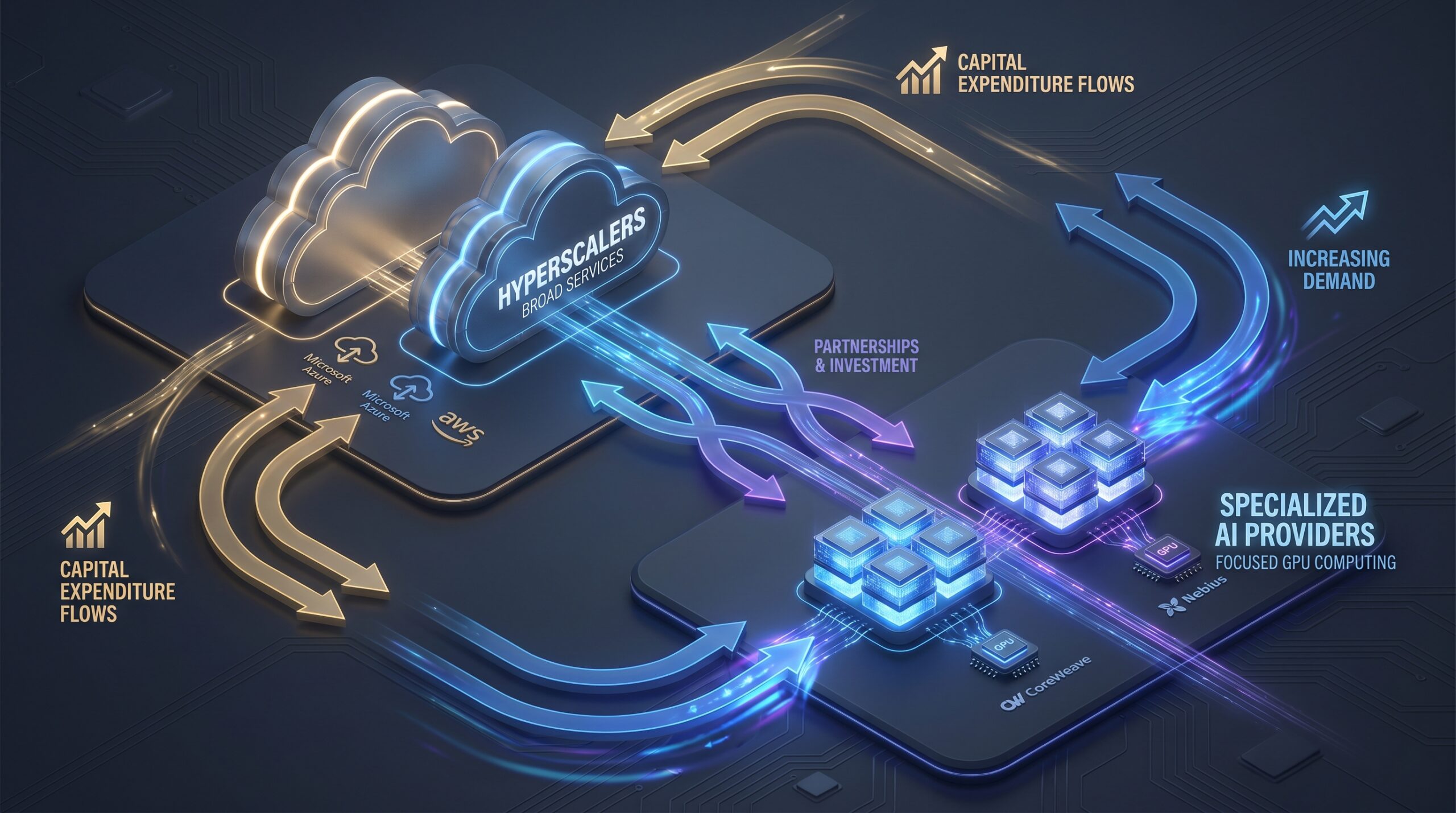
What makes 2026 particularly interesting is the emergence of a two-tier market. The hyperscalers (Microsoft Azure, AWS, Google Cloud) continue to dominate overall cloud services, but specialized AI infrastructure providers are capturing an increasingly large share of the most demanding AI workloads. This isn’t a zero-sum game—both segments are growing rapidly, but they serve different customer needs and have different risk profiles for investors.
Leading Cloud and AI Infrastructure Stocks for 2026
Several companies stand out as pivotal players in the cloud and AI infrastructure domain for 2026. Their diverse roles, from cloud service provision to semiconductor manufacturing, make them essential picks for investors looking to capitalize on this burgeoning market.
Understanding their individual contributions and market positions is key to forming a robust investment strategy. These leaders are not only driving innovation but also securing substantial market share through strategic investments and technological advancements.
Microsoft (MSFT)
Microsoft represents the most balanced investment in the cloud and AI infrastructure space. Their diversified business model combines enterprise software, cloud services, and consumer products with a comprehensive AI strategy. Azure’s 39% growth rate in the latest quarter demonstrates strong momentum in cloud services, while their integration of AI capabilities across the entire stack—from GitHub Copilot to Azure OpenAI Service—creates multiple revenue streams.
With 53 out of 56 analysts rating Microsoft a Buy and no Sell ratings as of April 2026, institutional confidence remains exceptionally high. The company’s approach of embedding AI throughout its existing products rather than relying on a single AI offering provides defensive characteristics during market volatility. Their enterprise relationships and long-term contracts create predictable recurring revenue that supports the massive infrastructure investments required to stay competitive.
Nvidia (NVDA)
Nvidia is the purest play on AI infrastructure demand. Their fiscal 2026 revenue jump of 65% to $215.9 billion reflects their dominant position in supplying the GPUs that power virtually all major AI training and inference workloads. While competitors like AMD are making inroads, Nvidia’s full-stack approach—combining hardware with CUDA software ecosystem—maintains their moat.
The company has successfully transitioned from primarily a gaming GPU manufacturer to the essential infrastructure provider for the AI revolution. Their data center revenue now dwarfs other segments, and their ongoing innovation in chip architecture (Blackwell GPUs) and networking technology (Spectrum-X) ensures they capture value across the entire AI infrastructure stack. The risk here is concentration—any slowdown in AI investment or successful competition could impact growth.
Nvidia’s AI Dominance: Nvidia’s comprehensive ecosystem, including specialized hardware like Blackwell GPUs and the foundational CUDA software platform, secures its leading position. This integrated approach creates high switching costs and ensures robust performance for demanding AI workloads, making it a critical supplier for data centers globally.
Amazon (AMZN) and AWS
Amazon’s cloud division, AWS, remains the market share leader in cloud infrastructure, though growing at a slightly slower pace than Microsoft Azure. The company’s commitment to AI is demonstrated by their additional $25 billion investment in Anthropic announced April 20, 2026, building on previous investments. This strategic partnership ensures AWS has preferential access to cutting-edge AI models while creating a compelling reason for developers to build on their platform.
AWS’s strength lies in its massive scale and comprehensive service catalog. While they may not be the fastest growing cloud provider, their profitability funds continued innovation and infrastructure expansion. Amazon’s unique combination of e-commerce, advertising, and cloud businesses creates synergies that others cannot match—their AI research improves recommendation engines which drives retail sales, which in turn generates more data to improve their AI models.
Broadcom (AVGO)
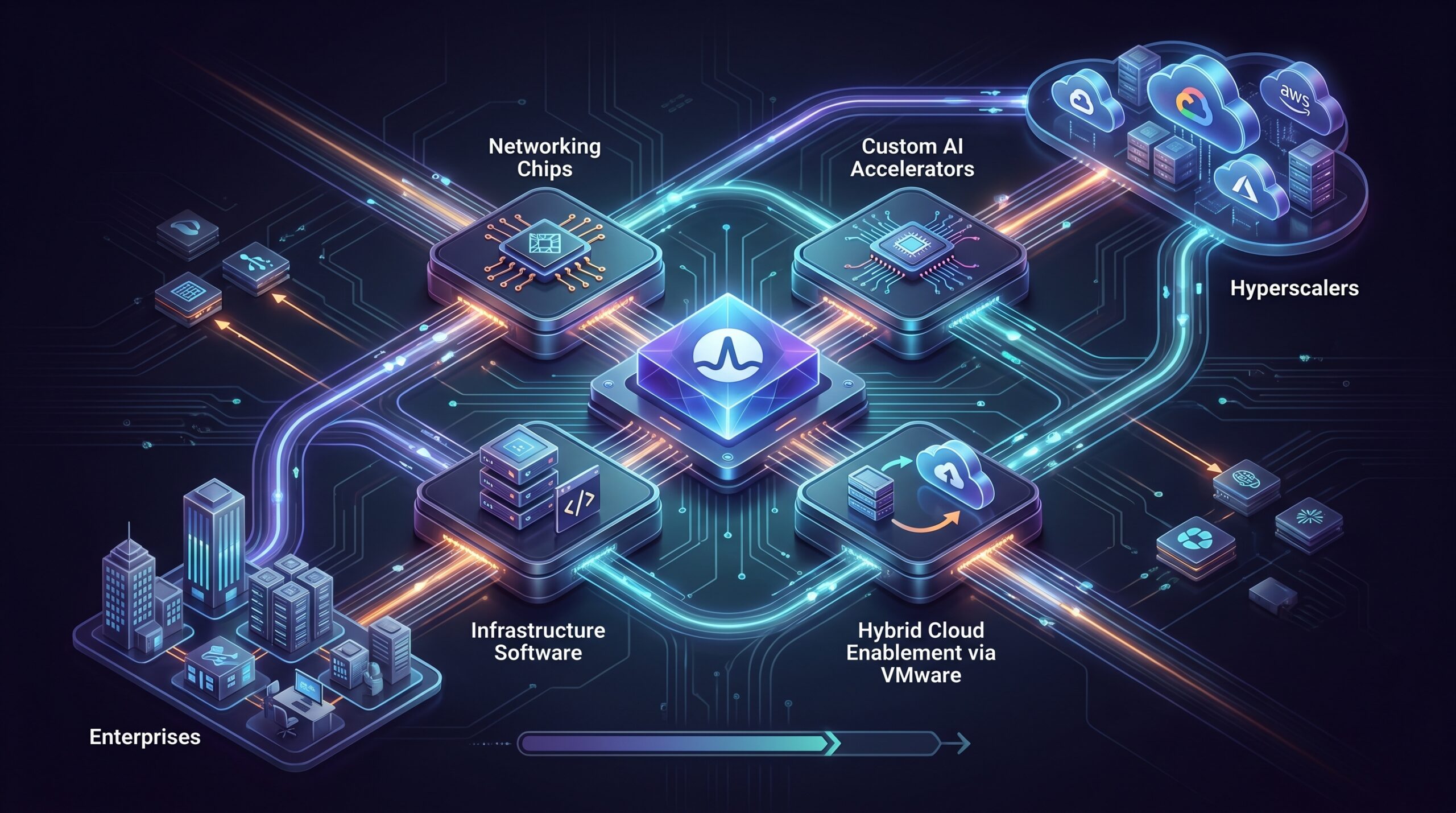
Broadcom plays a critical but less visible role in the AI infrastructure ecosystem. As a semiconductor company, they provide essential networking chips, custom AI accelerators, and infrastructure software. Their acquisition of VMware has positioned them as a key enabler of hybrid cloud environments, which remain important despite the shift toward public cloud.
The company’s focus on profitable market segments and strategic partnerships with hyperscalers makes them a more conservative play on AI infrastructure growth. Their diversified semiconductor business across networking, broadband, wireless, and storage provides stability during cyclical downturns in any single segment. Broadcom’s approach of developing custom solutions for large cloud providers creates high switching costs and durable revenue streams.
Arista Networks (ANET)
Arista provides the networking foundation that enables AI data centers to function at scale. As AI workloads require massive amounts of data transfer between GPUs, traditional networking solutions become bottlenecks. Arista’s high-speed Ethernet solutions specifically optimized for AI clusters have positioned them as the preferred vendor for many cloud providers and enterprises building AI infrastructure.
The company’s growth comes from both market expansion (AI driving increased networking demand) and market share gains (taking business from traditional competitors). Their software-driven approach allows for better monitoring and management of network performance, which is critical when AI training jobs costing millions of dollars depend on network reliability. Arista’s focus on a few key products rather than a broad portfolio has allowed them to maintain technological leadership.
Specialized AI Cloud Providers
Beyond the traditional hyperscalers, a new breed of cloud providers has emerged, focusing exclusively on the unique demands of AI workloads. These specialized entities are carving out significant market share by offering optimized infrastructure and services that general-purpose clouds cannot match in terms of performance and cost-efficiency for specific AI tasks.
Their rapid growth and substantial contracts underscore a clear market need for dedicated high-performance computing. Investors are increasingly looking to these agile players for potentially higher returns, albeit with corresponding higher risks associated with aggressive expansion and competitive pressures.
CoreWeave
CoreWeave represents the new class of specialized cloud providers focused exclusively on GPU-accelerated computing. Their April 2026 $6 billion deal with trading firm Jane Street demonstrates the demand for dedicated high-performance computing capacity from sophisticated users. With a $66.8 billion backlog and $58 billion market cap, CoreWeave has become a significant force despite being much younger than the hyperscalers.
The company’s focus on NVIDIA GPUs and optimized infrastructure for AI workloads allows them to deliver better price-performance for specific use cases than general-purpose clouds. Their growth strategy involves securing long-term capacity contracts with both customers and hardware suppliers, then leveraging those commitments to raise capital for expansion. This creates execution risk—if they cannot deploy capital efficiently or if demand slows, their high valuation could be vulnerable.
Nebius
Nebius has emerged as another major player in the specialized AI cloud space, with astonishing growth metrics. Their 547% year-over-year revenue growth in Q4 2025 to $228 million shows how rapidly this market is expanding. The expanded deal with Meta Platforms in March 2026 for up to $27 billion (including $12 billion in dedicated capacity and $15 billion in additional services) demonstrates their ability to secure contracts with the largest tech companies.
Their projection of increasing annual run rate from $1.25 billion at end of 2025 to $7-9 billion by end of 2026 represents one of the most aggressive growth targets in the sector. This requires flawless execution and continued strong demand for dedicated AI capacity. Nebius’s focus on providing entire AI infrastructure stacks rather than just raw compute differentiates them from some competitors and may justify higher valuation multiples.
Essential Infrastructure Support Companies
Beyond the direct providers of cloud and AI services, a robust ecosystem of support companies forms the backbone of this rapidly evolving sector. These entities, while sometimes less visible, are absolutely critical for the efficient operation and expansion of AI infrastructure. Their contributions range from specialized networking to critical components and edge solutions.
Investing in these supportive companies offers diversified exposure to the AI boom. They often provide stable revenue streams as their products are integral to the functionality of the larger cloud and AI environments, regardless of which specific AI models gain traction.
Networking Infrastructure
AI data centers require completely different networking architectures than traditional data centers. The need for low-latency, high-bandwidth connections between thousands of GPUs has created a renaissance in networking technology. Companies like Arista, but also Juniper Networks and Cisco, are developing specialized solutions for AI workload requirements.
The shift from traditional north-south data center traffic patterns to east-west GPU-to-GPU communication patterns has driven adoption of new technologies like RDMA over Converged Ethernet (RoCE). This requires both specialized hardware and sophisticated software to manage congestion and ensure consistent performance. Networking companies that successfully navigate this transition are capturing significant value from the AI infrastructure buildout.
Semiconductor and Component Suppliers
Beyond Nvidia, multiple semiconductor companies benefit from the AI infrastructure expansion. AMD has gained traction with their Instinct GPUs and acquisition of Xilinx provides FPGA technology useful for certain AI workloads. Companies like Broadcom provide essential networking chips, while memory manufacturers like Micron benefit from increased DRAM and flash storage requirements in AI servers.
The AI infrastructure buildout also drives demand for power management components, cooling systems, and specialized server chassis. Companies that provide these less glamorous but essential components represent more indirect plays on the AI trend. Their fortunes are tied to the overall volume of data center construction rather than the success of any particular AI model or application.
Semiconductor Ecosystem: The AI infrastructure explosion benefits a broad array of semiconductor firms beyond just GPU manufacturers. Critical components like high-speed memory (DRAM), specialized networking chips, power management solutions, and even cooling system components are experiencing surging demand, creating a diversified investment opportunity across the supply chain.
Edge AI Infrastructure
While much attention focuses on massive cloud data centers, edge AI infrastructure represents a growing segment. Companies like Calix are integrating AI capabilities into broadband provider workflows, enabling more intelligent network management and new services. The BEAD program funding for federal broadband deployment expected to accelerate in 2026 creates a tailwind for these companies.
Edge AI requires different infrastructure considerations than cloud AI—lower power consumption, smaller form factors, and different reliability requirements. Companies that can deliver AI processing capabilities in constrained environments stand to benefit as AI applications proliferate beyond massive data centers. This segment may grow more slowly than cloud AI infrastructure but offers diversification within the broader theme.
Comparison of Leading Cloud and AI Infrastructure Stocks
| Company | Key Role | Recent Growth | Analyst Sentiment | Noteworthy |
|---|---|---|---|---|
| Microsoft | Hyperscaler, Enterprise Cloud & AI | 17% total revenue growth, 39% Azure growth | 53 Buy, 3 Hold (out of 56) | Most balanced pick, heavily invested in AI |
| Nvidia | AI Hardware (GPUs), Data Center | 65% revenue jump to $215.9B (FY2026) | Strong positive | Most direct AI data center investment |
| Amazon | Hyperscaler (AWS), AI Investments | Heavy investment in AI companies | Strong positive | Investing $25B more in Anthropic |
| Broadcom | Semiconductors, Infrastructure Software | Positive among leading stocks | Positive | Reflects AI acceleration themes |
| Arista Networks | Cloud Networking | Strong growth and support | Positive | Essential networking for AI data centers |
Comparison of Specialized AI Cloud Providers
| Company | Key Role | Recent Deals | Backlog/Market Cap | Growth Potential |
|---|---|---|---|---|
| CoreWeave | Specialized GPU-accelerated AI Cloud | $6B from Jane Street, Meta/Anthropic pacts | $66.8B backlog, $58B market cap | Targeted to $125 stock price, high execution risk |
| Nebius | Dedicated AI Cloud Capacity | $46B in AI cloud deals, $27B expanded Meta deal | 547% Y-o-Y growth to $228M (Q4) | Projected $7-9B run rate by end of 2026 |
Investment Considerations and Risk Assessment
Investing in the dynamic cloud and AI infrastructure sector requires a careful assessment of various risks and a clear understanding of common pitfalls. The rapid pace of technological change and immense capital requirements demand continuous vigilance from investors. A thorough analysis transcends headline growth numbers and delves into the operational and financial health of these companies.
Identifying and mitigating these risks is crucial for long-term investment success. This section outlines the sector-specific challenges, common investor errors, and prevailing myths that can lead to suboptimal decisions.
Sector Risks
The cloud and AI infrastructure sector faces several significant risks that investors must consider. First is the enormous capital expenditure requirement—companies that cannot sustain massive ongoing investments risk falling behind technologically. Alphabet’s $175-185 billion 2026 CapEx plan illustrates the scale required to compete at the hyperscaler level.
Execution risk is particularly acute for specialized providers like CoreWeave and Nebius. Their aggressive growth targets (Nebius projecting $7-9 billion run rate by end of 2026 from $1.25 billion at end of 2025) require flawless execution in a complex supply-constrained environment. Any missteps in capacity deployment or customer onboarding could significantly impact their valuations.
Competition is intensifying across all segments. The hyperscalers are adding AI-specific services, while new specialized providers enter the market regularly. This competition could drive down pricing and compress margins over time. Additionally, economic downturns could reduce enterprise spending on cloud and AI initiatives, impacting growth across the sector.
Common Investment Mistakes
Many investors make the mistake of focusing only on the most visible AI companies while ignoring the essential infrastructure providers. The companies building the foundational technologies often have more predictable revenue streams than application-layer AI companies whose success depends on specific product adoption.
Another common error is failing to differentiate between hyperscalers and specialized providers. Hyperscalers offer relative stability and diversification but may have slower growth rates. Specialized providers offer higher growth potential but also higher risk and volatility. Investors should align their choices with their risk tolerance and investment timeframe.
Underestimating the importance of cash flow and balance sheet strength is another pitfall. The massive capital requirements of building AI infrastructure mean that companies with strong cash generation or access to capital markets have significant advantages. Investors should carefully review cash flow statements and debt levels, particularly for high-growth companies burning cash to expand capacity.
Myths and Misconceptions
A common myth is that AI infrastructure is only about Nvidia GPUs. While Nvidia is dominant, the ecosystem includes companies providing networking, storage, power management, cooling, and specialized software—all essential components. Investors should consider the entire infrastructure stack rather than focusing on a single component.
Another misconception is that cloud growth is slowing. While growth rates have normalized from pandemic peaks, the absolute dollar growth remains enormous due to the larger base. The integration of AI capabilities is driving a new wave of cloud adoption and workload migration that may sustain growth rates above historical averages for several years.
Finally, some believe only the biggest tech companies will succeed in AI infrastructure. The emergence of specialized providers like CoreWeave and Nebius demonstrates that focused companies can capture significant market share. Their ability to move faster and specialize in specific workloads gives them advantages in particular segments despite smaller overall size.
AI Infrastructure Investment Pitfalls
- Over-reliance on visible AI companies: Overlooking essential, less visible infrastructure providers.
- Ignoring cash flow and balance sheet: Underestimating capital requirements; neglecting debt levels or cash burn.
- Believing AI infrastructure is solely about GPUs: Neglecting crucial components like networking, storage, power, and software.
- Misinterpreting cloud growth: Assuming slowed growth when absolute dollar growth remains substantial due to AI integration.
- Believing only large tech will win: Dismissing specialized providers who offer focused advantages despite smaller scale.
Implementation Strategy for Investors
Developing an effective investment strategy for cloud and AI infrastructure stocks involves more than simply picking individual companies. It requires a holistic approach to portfolio allocation, continuous monitoring of key metrics, and an awareness of market timing. This strategy should align with individual risk tolerance and investment goals to maximize potential returns while managing exposure to inherent sector volatility.
A well-thought-out implementation leverages diversification and focuses on long-term trends rather than short-term fluctuations. This helps investors navigate the complexities of a rapidly evolving technological landscape and capitalize on sustained growth.
Portfolio Allocation Approach
Investors should consider their cloud and AI infrastructure allocations within the context of their overall portfolio risk tolerance. A conservative approach might emphasize established hyperscalers like Microsoft and Amazon, which offer AI exposure alongside diversified businesses. These companies provide relative stability with still-impressive growth rates.
More aggressive investors might allocate to pure-play companies like Nvidia or specialized providers like CoreWeave. These offer higher growth potential but also higher volatility and specific execution risks. A balanced approach might combine hyperscalers with selected pure-play companies to capture growth while maintaining some diversification.
Sector concentration risk is an important consideration—investing too heavily in any single technology sector increases portfolio vulnerability to sector-specific downturns. Most investors should limit technology sector exposure to appropriate levels based on their investment objectives and risk tolerance.
Monitoring Key Metrics
Investors should track several key metrics when evaluating cloud and AI infrastructure companies. Revenue growth remains important, but investors should also monitor gross and operating margins to ensure growth is profitable. For companies investing heavily in capacity expansion, tracking capital efficiency (revenue generated per dollar of CapEx) provides insight into investment quality.
For specialized cloud providers, capacity utilization rates and backlog conversion rates are critical indicators. High backlog suggests strong demand, but the ability to convert that backlog into revenue without significant delay determines actual financial performance. Contract duration and customer concentration also matter—diverse long-term contracts provide more predictable revenue.
Balance sheet strength becomes increasingly important during periods of rapid expansion. Companies with strong cash generation or access to low-cost capital can fund growth more comfortably than those relying on expensive financing. Debt levels and interest coverage ratios should be monitored, especially for companies with aggressive expansion plans.
Timing Considerations
The AI infrastructure buildout is likely a multi-year trend rather than a short-term phenomenon. However, valuations can become disconnected from fundamentals during periods of excessive optimism. Investors should consider valuation metrics alongside growth prospects rather than chasing performance indiscriminately.
Entry points matter—adding positions during market pullbacks or when specific companies face temporary challenges can improve long-term returns. Dollar-cost averaging into positions rather than making large lump-sum investments can help manage timing risk for volatile stocks.
Investors should also consider the stage of the investment cycle—early cycle investments in emerging companies offer higher potential returns but higher risk, while later cycle investments in established players offer more certainty but potentially lower returns. Aligning investments with personal risk tolerance and investment horizon is essential.
Future Outlook and Trends
The future of cloud and AI infrastructure is characterized by continuous innovation and evolving market dynamics. New technological advancements, changes in market structure, and broader investment implications will shape the landscape in the coming years. Staying abreast of these trends is essential for investors seeking to maintain a competitive edge.
Understanding these future directions helps to anticipate shifts in investment opportunities and potential risks. This forward-looking perspective ensures that investment strategies remain agile and responsive to the rapid advancements within this critical sector.
Technology Evolution
The AI infrastructure landscape continues to evolve rapidly. New chip architectures from Nvidia, AMD, and custom silicon providers promise improved performance and efficiency. The transition to liquid cooling from air cooling enables denser data centers but requires different infrastructure investments.
Networking technology is advancing to support increasingly large AI clusters—800G Ethernet deployment is accelerating in 2026, with 1.6T technology on the horizon. These advancements enable larger and more efficient AI models but require continuous infrastructure upgrades.
Software-defined infrastructure and AI-powered management tools are becoming increasingly important for optimizing resource utilization across complex AI workloads. Companies that can deliver better performance through software innovation may gain competitive advantages even with similar hardware.
Market Structure Changes
The AI infrastructure market may see continued specialization, with providers focusing on specific workload types or industry verticals. While hyperscalers offer broad capabilities, specialized providers can deliver better price-performance for particular use cases through optimized stacks.
Consolidation is likely as larger players acquire specialized capabilities or customers. The massive capital requirements for building AI infrastructure create barriers to entry that may lead to smaller players being acquired rather than continuing as independent companies.
Geographic expansion is another trend—as data sovereignty concerns grow, providers are building capacity in more regions to serve local regulations. This creates both opportunities (new markets) and challenges (operational complexity) for infrastructure providers.
Investment Implications
The long-term investment implications of AI infrastructure growth remain compelling. Even if AI application development slows, the infrastructure already built will find uses in other computational workloads. The shift toward accelerated computing appears durable across multiple market cycles.
Investors should focus on companies with sustainable competitive advantages rather than those simply riding a wave of enthusiasm. Technological leadership, scale advantages, customer switching costs, and capital allocation discipline will determine long-term winners more than short-term growth metrics.
Diversification across infrastructure layers—hardware, cloud services, networking, etc.—may provide better risk-adjusted returns than concentration in any single segment. The interdependency of these layers means growth in one typically benefits others, while providing some protection if any particular segment faces challenges.
FAQ: Cloud and AI Infrastructure Stocks 2026
- What are the best cloud and AI infrastructure stocks for 2026?
- Microsoft, Nvidia, and Amazon are consistently identified as leading stocks, backed by strong analyst ratings and substantial growth. Microsoft offers the most balanced exposure, Nvidia provides the most direct AI data center investment, and Amazon maintains cloud leadership with significant AI investments. Specialized providers like CoreWeave and Nebius offer higher growth potential but with higher risk.
- How does Nvidia maintain its dominance in AI chips?
- Nvidia combines advanced GPU hardware with a comprehensive software ecosystem (CUDA, AI frameworks, libraries) that creates significant switching costs for developers. Their full-stack approach—from chips to systems to software—and continuous innovation (new architectures like Blackwell) maintain their competitive advantage despite increasing competition from AMD and others.
- What is the difference between hyperscalers and specialized AI cloud providers?
- Hyperscalers (Microsoft Azure, AWS, Google Cloud) offer broad cloud services across computing, storage, networking, and applications. Specialized AI providers (CoreWeave, Nebius) focus exclusively on GPU-accelerated computing for AI workloads, often delivering better price-performance for specific use cases through optimized infrastructure and operations.
- How sustainable is the current growth in AI infrastructure investment?
- The growth appears sustainable medium-term due to several factors: continued AI model advancement requiring more computation, enterprise AI adoption still in early stages, and replacement cycles for existing infrastructure with AI-optimized systems. However, cyclical fluctuations are inevitable in technology investing, and valuations already reflect substantial growth expectations.
- What risks should investors consider with AI infrastructure stocks?
- Key risks include execution risk for companies with aggressive expansion plans, competitive pressures that could compress margins, economic downturns reducing enterprise spending, supply chain constraints limiting growth, and regulatory changes affecting technology companies. Valuation risk is also significant given high expectations embedded in many stocks.
- How important are capital expenditures for evaluating these companies?
- Capital expenditures are critical—companies that cannot sustain massive ongoing investments risk risking falling behind technologically. However, investors should distinguish between growth CapEx (expanding capacity) and maintenance CapEx (replacing existing equipment). Growth CapEx should generate future returns, while high maintenance CapEx may indicate competitive disadvantages.
- What role do networking companies play in AI infrastructure?
- Networking companies provide the high-speed connections between AI processors that enable distributed training and inference. AI workloads require significantly different networking patterns than traditional applications, with more east-west traffic between GPUs rather than north-south traffic to users. Companies that provide optimized networking solutions are essential enablers of AI at scale.
Key Takeaways for Cloud and AI Infrastructure Stocks 2026
- Leading players like Microsoft, Nvidia, and Amazon are critical for diversified exposure and direct AI investment.
- Specialized AI cloud providers such as CoreWeave and Nebius offer high-growth, high-risk opportunities.
- Essential support companies (e.g., Broadcom, Arista Networks) provide diversified, foundational exposure.
- Investment success hinges on understanding sector risks, avoiding common mistakes, and strategic portfolio allocation.
- The sector’s rapid evolution demands continuous monitoring of technology, market structure, and company financials.