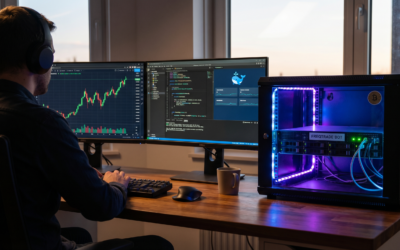

Effective bankroll management is the critical framework that determines how much capital to risk per trade and how to adjust that amount over time based on bot performance and market conditions. It’s the meta-strategy that governs your trading strategy, ensuring longevity and preventing account blow-ups in volatile 2026 markets.
TL;DR
- Capital preservation is the priority—surviving bots can iterate and improve
- Risk no more than 1-2% of total bankroll on any single trade, never exceed 5%
- Your strategy’s statistical edge should dictate position sizing through methods like Fractional Kelly
- Dynamic sizing that adjusts based on recent performance beats static approaches
- Separate bankroll management logic from strategy logic for modular robustness
Key takeaways
- Implement fixed 1% risk rules immediately as your baseline protection
- Separate risk management logic from strategy code for modular robustness
- Define drawdown protocols before emotional decisions are necessary
- Backtest with realistic fee and slippage models, not perfect execution
- Monitor asset correlation to avoid concentrated risk exposure
What Is Trading Bot Bankroll Management?
Bankroll management is the systematic framework you use to decide how much capital to risk per trade and how to adjust that amount over time based on the performance of your bot and the conditions of the market.
It is not a trading strategy. It is the meta-strategy that governs your strategy. A brilliant signal generator can be rendered useless by poor position sizing, while a mediocre strategy with impeccable risk management can be consistently profitable.
The Core Components
- Position Sizing: The calculation that translates a trade signal into a specific dollar or crypto amount
- Risk Per Trade: The maximum amount of capital you are willing to lose on a single trade, expressed as a percentage of your bankroll
- Drawdown Controls: Rules that trigger a reduction in position size or complete trading halt after certain loss levels
- Bankroll Growth/Shrinkage Protocol: Predefined plan for adjusting trade sizes during winning and losing streaks
Why Bankroll Management Matters More Than Ever in 2026
The trading bot landscape has matured significantly. The differentiation between successful and failed operators is no longer just about who has the fastest API or the most complex machine learning model. It’s about who can manage risk systematically over the long term.
Three Key Drivers
- High-Frequency, Multi-Pair Bots: Bots can execute hundreds of trades daily across dozens of pairs, making strict risk limits essential to prevent cascade failures
- Increased Market Integration: Macroeconomic events cause synchronized movements across crypto, equities, and forex, reducing effective diversification
- Sophisticated Infrastructure Access: Platforms like Freqtrade and Hummingbot have democratized advanced execution, increasing competition and raising the bar for risk discipline
How Bankroll Management Works: From Theory to Code
Let’s break down how you translate a risk percentage into an executable trade size within a bot’s logic.
The Basic Formula: Fixed Fractional Position Sizing
This is the bedrock. You risk a fixed percentage of your current total bankroll on every trade.
Formula: Position Size = (Total Bankroll * Risk Percentage Per Trade) / (Entry Price - Stop Loss Price)
Implementing Dynamic Position Sizing
A more advanced approach adjusts risk percentage based on performance, often through drawdown-based scaling.
# Pseudo-code for dynamic sizing
current_equity = get_current_portfolio_value()
peak_equity = max(peak_equity, current_equity) # Track high watermark
drawdown = (peak_equity - current_equity) / peak_equity

if drawdown >= 0.05: # 5% drawdown
    risk_per_trade = 0.01
else:
    risk_per_trade = 0.02

position_size = calculate_position_size(current_equity, risk_per_trade, entry_price, stop_loss)
Advanced Method: Fractional Kelly Sizing
The Kelly Criterion determines optimal bet size to maximize long-term growth given probability of winning and win/loss ratio. Fractional Kelly (like Half-Kelly) reduces volatility.
Real-World Examples and Use Cases
Case Study 1: The Conservative Freqtrade Operator
Runs mean-reversion bot on 20 altcoin pairs using simple 1% fixed fractional sizing. Over six months, worst drawdown was 12%, psychologically manageable. The bot survived high volatility that wiped out aggressive traders, demonstrating that consistency trumps heroics.
Case Study 2: The Aggressive Perpetuals Bot on Hyperliquid
Runs momentum bot on Bitcoin and Ethereum perpetual futures with 5x leverage using dynamic position sizing. Baseline risk is 2.5% per trade, but system automatically reduces positions by 50% after 5% drawdown and halts trading after 15% drawdown for 48-hour cooling period.
Comparison of Position Sizing Methods
| Method | How It Works | Best For | Major Pitfall |
|---|---|---|---|
| Fixed Fractional | Risks fixed % of bankroll on every trade | Beginners, low-frequency strategies | Slow capital growth; doesn’t adapt to performance |
| Fixed Ratio | Increases position size by fixed amount per profit goal | Futures traders with defined contract sizes | Can become overly aggressive quickly |
| Dynamic (Drawdown-Based) | Adjusts risk % based on current drawdown from equity peak | Intermediate operators, strategies prone to drawdown | Complexity; requires robust equity tracking |
| Fractional Kelly | Uses statistical edge to optimize bet size | Advanced operators with reliable backtest data | Highly sensitive to inaccurate edge estimation |
Tools, Vendors, and Implementation Path
You don’t need expensive software. Effective bankroll management starts with your bot’s code.
For Freqtune / Custom Script Developers
The logic must be baked in. Create a dedicated risk_manager.py module that calculates position size for any given signal, separating concerns for robustness.
Platforms with Built-in Features
- Freqtrade: Has
stake_amountparameter set to ‘unlimited’, fixed amount, or percentage of wallet - Hummingbot: Uses
order_amountin scripts designed as percentage of total portfolio value
Advanced Infrastructure
Services like QuantVPS offer optimized servers for running trading bots, providing stable environment for reliable risk management code execution 24/7.
How to Leverage This for Profit and Career Advancement
This knowledge isn’t just about saving your own capital; it’s a marketable skill.
- Earn by Not Losing: Proper sizing is the difference between a bot that survives a bad month and one that deletes your account
- Build a Track Record: Solid bankroll management allows multi-year track records valuable for attracting investment
- Become a Quant Analyst: Understanding sophisticated risk models is core competency for professional quant roles
- Audit and Consult: Position yourself as an expert who can review code and ensure systems are built for longevity
Risks, Pitfalls, and Myths vs. Facts
Pitfalls to Avoid
- Overfitting Sizing to Backtests: Future market conditions differ—use conservative fractions
- Ignoring Correlated Assets: Trading multiple altcoins that move with Bitcoin creates concentrated risk
- Underestimating Slippage and Fees: Real execution costs can obliterate strategies with small target profits
Myths vs. Facts
Myth: “If I have a high-win-rate strategy, I can risk more per trade.”
Fact: A 90% win rate means nothing if the 10% of losses are large enough to wipe out gains. The ratio of average win to average loss is just as important.
Myth: “Bankroll management is only for small accounts.”
Fact: While crucial for small accounts to avoid ruin, it’s equally important for large accounts. A 10% loss on $100,000 is a $10,000 mistake.
Myth: “My stop loss guarantees my maximum loss.”
Fact: In volatile, illiquid markets or during flash crashes, stop losses can execute far below trigger prices due to slippage.
Frequently Asked Questions (FAQ)
Q: I’m starting with a $1,000 account. What’s the simplest way to start?
A: Use fixed fractional position sizing with conservative 1% risk per trade ($10 max loss per trade). This forces focus on finding quality trades.
Q: How often should I re-calculate my bankroll for position sizing?
A: Calculate based on bankroll at moment trade signal is generated. No need to adjust sizes for open trades intraday unless monitoring real-time volatility.
Q: Is it better to use total account balance or just allocated trading capital?
A: Use only capital explicitly allocated to the trading bot. This isolates performance and risk.
Q: How do I handle leverage with position sizing?
A: Leverage multiplies risk. The 1-2% risk rule should apply to your total capital at risk, not just the margin posted.
Key Takeaways and Actionable Next Steps
- Start Conservatively: Implement fixed 1% risk rule in your bot today
- Decouple Logic: Separate strategy code from position sizing code with
risk_managerfunction - Define Your Drawdown Protocol: Write rules now for 10% and 20% drawdown responses
- Backtest with Realism: Include trading fees and realistic slippage models
- Monitor Correlation: Regularly check if traded assets are becoming more correlated
Glossary
- Bankroll: Total capital allocated to trading bot or strategy
- Position Sizing: Process of determining how much capital to allocate to specific trade
- Drawdown: Peak-to-trough decline in trading account value during specific period
- Risk of Ruin: Probability of losing certain percentage of bankroll based on trading statistics
- Kelly Criterion: Formula for bet sizing that maximizes long-term growth rate of capital
- Slippage: Difference between expected trade price and actual execution price
References
- Skywork.ai – Strict Position Sizing Guidelines
- mBotopoly – Fixed Percentage Risk Methodology
- QuantVPS – Dynamic Position Sizing Implementation
- GitHub – Fully-Autonomous-Polymarket-AI-Trading-Bot Fractional Kelly Sizing
- Freqtrade Official Documentation – Stake Amount Parameters
- Hummingbot – Order Amount Script Design
This article is for educational purposes only. Trading carries significant risk, and past performance is not indicative of future results. Always conduct your own research and consider consulting with a qualified financial advisor before risking capital.