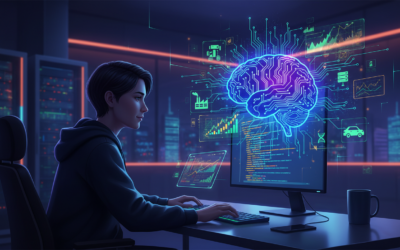
Decentralized AI models on blockchain are artificial intelligence systems distributed across blockchain networks rather than being controlled by single entities. In 2026, these models leverage autonomous AI agents capable of independent action, maintaining full auditability, and utilizing blockchain’s immutable ledger for transparent governance and verifiable execution across networks like Bittensor, Ocean Protocol, and Lithosphere.
TL;DR: Decentralized AI models on blockchain have moved into production in 2026, enabling AI agents to interact with smart contracts on transparent, auditable networks. This integration fosters an ‘AI Summer’ of rapid growth in decentralized compute, AI agents, and data marketplaces, offering benefits like transparent governance, reduced centralization risks, and improved data privacy.
Decentralized AI Models Blockchain: 2026 Production Guide & Ecosystem Map
Decentralized AI models on blockchain have moved from pilot projects to production systems in 2026. Autonomous AI agents now execute transactions, manage wallets, and interact with smart contracts under programmable controls. Blockchain provides immutable audit trails for data provenance, model changes, and inference events, creating trusted, transparent AI systems while enabling adaptive decision-making in previously rigid decentralized networks. This integration has sparked an ‘AI Summer’ of rapid growth across decentralized compute networks, AI agents, and data marketplaces.
What Are Decentralized AI Models on Blockchain?
Decentralized AI models are artificial intelligence systems distributed across blockchain networks rather than controlled by single entities. They enable collaborative development, verifiable execution, and transparent governance through blockchain’s immutable ledger. In 2026, these models leverage autonomous AI agents capable of independent action — holding crypto wallets, executing transactions, and interacting with smart contracts while maintaining full auditability.
Key characteristics include:
- Distributed ownership: No single entity controls model training, deployment, or updates.
- Immutable audit trails: All data provenance, model changes, and inference events are logged on-chain.
- Token-incentivized networks: Cryptocurrencies reward data providers, compute providers, and model developers.
- Interoperable infrastructure: Designed to work across multiple blockchains and AI frameworks.
The Blockchain Council confirms AI-blockchain integration has shifted from theoretical pilots to production implementations throughout 2026, with particular growth in financial applications, healthcare diagnostics, and supply chain optimization.
How Blockchain Decentralizes AI Models
Blockchain technology provides four fundamental capabilities that enable truly decentralized AI:
Immutable Model Provenance
Every change to an AI model — training data additions, parameter adjustments, architecture modifications — gets recorded on-chain with cryptographic verification. This creates permanent, tamper-proof records of model evolution that auditors, regulators, and users can verify independently.
Decentralized Compute Networks
Projects like Bittensor create global marketplaces for computational resources where GPU owners can rent capacity to AI developers. This eliminates reliance on centralized cloud providers while creating competitive pricing through decentralized commodity markets.
Verifiable Inference Logging
When AI models make predictions or generate content, the input data and output results can be hashed and stored on-chain. This provides proof of how specific decisions were made, crucial for regulatory compliance in industries like finance and healthcare.
Autonomous Economic Agents
AI programs can now hold cryptocurrency wallets, pay for computational resources, and receive payments for services rendered — all without human intervention. These agents operate under programmable constraints that ensure ethical behavior and financial controls. Learn more about how AI agents manage memory and context retention in our guide to Hippo AI Agent Memory.
Key Benefits of Decentralized AI on Blockchain
Transparent Model Governance
Organizations can prove exactly how their AI models were developed, what data was used, and how decisions are made. This addresses the ‘black box’ problem that plagues traditional AI systems and builds trust with users and regulators.
Reduced Centralization Risks
Eliminating single points of failure prevents the concentration of AI power among few tech giants. Distributed model training and execution ensures no single entity controls critical AI infrastructure.
Improved Data Privacy
Techniques like federated learning allow model training on decentralized data without exposing raw information. Participants contribute to improving AI models while maintaining data sovereignty.
Global Resource Access
Developers in emerging markets can access computational resources and datasets through decentralized marketplaces, lowering barriers to AI development and creating more diverse AI ecosystems.
Economic Incentive Alignment
Token-based reward systems ensure data contributors, compute providers, and model developers receive fair compensation for their contributions to AI networks.
Decentralized AI Blockchain Ecosystem 2026
The decentralized AI landscape has matured significantly by 2026, with specialized projects addressing different aspects of the AI development lifecycle.
Decentralized AI Model Training Networks
Bittensor (TAO)
Bittensor operates as an open-source, decentralized network for global AI and machine learning model training. The network creates a marketplace where AI models compete to provide the most accurate predictions, with better models earning more TAO tokens. This incentive structure drives continuous improvement through collective intelligence.
Key features:
- Peer-to-peer intelligence exchange between AI models
- On-chain reputation system for model performance
- Distributed training across global compute resources
- TAO token rewards for valuable predictions
Neura
Neura is building an AI-focused Layer 1 blockchain specifically designed for decentralized model training, autonomous agents, and verifiable AI outputs. The platform aims to provide infrastructure for creating, training, and deploying AI models in fully decentralized environments.
Decentralized Data Marketplaces
Ocean Protocol
Ocean Protocol facilitates secure, decentralized data sharing and monetization for AI training. The platform enables data owners to maintain control over their datasets while allowing AI developers to access and compute on the data without full centralization. Ocean uses blockchain to manage data access permissions, audit data usage, and handle micropayments for data services.
Implementation examples:
- Healthcare organizations sharing medical imaging data for AI diagnostics
- Financial institutions collaborating on fraud detection models
- Research institutions pooling datasets for scientific discovery
AI-Native Blockchain Infrastructure
Lithosphere with Makalu Testnet
Lithosphere activated its Makalu Testnet on April 2, 2026, providing infrastructure specifically designed for AI-native blockchain systems. The testnet supports autonomous digital coordination and intelligent execution environments built from the ground up for AI integration.
Lithic Smart Contract Language
On April 7, 2026, Lithosphere introduced Lithic — an AI-native smart contract language designed for structured intelligent execution. Unlike traditional smart contract languages that focus on deterministic outcomes, Lithic incorporates probabilistic reasoning and machine learning capabilities directly into contract logic.
Lithic enables:
- AI-driven conditional execution based on predictive analytics
- Adaptive contract terms that evolve based on real-world data
- Integration of external AI models into blockchain operations
- Verifiable execution of AI-enhanced smart contracts
Decentralized AI Commerce Ecosystems
Grokarium (GROK)
Grokarium has expanded its decentralized commerce ecosystem throughout April 2026, specifically integrating and enhancing Grok AI capabilities on blockchain. The platform enables AI-driven commerce applications where autonomous agents can facilitate transactions, negotiate terms, and manage supply chains without human intervention.
Decentralized AI Models Blockchain Comparison
| Project Category | Leading Projects | Primary Function | Current Status (2026) |
|---|---|---|---|
| Model Training/Development | Bittensor, Neura | Decentralized AI model training and collaboration | Production deployment, active token economies |
| Data Sharing for AI | Ocean Protocol | Secure data marketplace for AI training | Enterprise adoption, healthcare implementations |
| AI-Native Infrastructure | Lithosphere (Makalu Testnet) | Blockchain built for AI integration | Testnet active, mainnet anticipated 2026 |
| AI Execution/Agents | Neura, Lithosphere (Lithic) | Autonomous AI agents and smart contracts | Early production, rapid development |
| Commerce with AI | Grokarium | AI-enhanced decentralized commerce | Ecosystem expansion throughout 2026 |
Technological Capabilities Comparison
| Capability | Implementation Examples | Impact on Decentralized AI |
|---|---|---|
| Immutable Audit Trails | Blockchain logging of data provenance, model changes | Enables regulatory compliance, model verification |
| Adaptive Decision-Making | AI adding risk scoring, anomaly detection | Makes decentralized systems responsive to real-world conditions |
| AI-Native Smart Contracts | Lithic language for intelligent execution | Enables complex, AI-driven contract logic |
| Global Compute Networks | Bittensor’s distributed training infrastructure | Lowers barriers to AI development resources |
| Autonomous Economic Agents | AI managing wallets, executing transactions | Creates self-operating AI businesses and services |
Real-World Applications in Production
Financial Risk Assessment
Decentralized AI models now provide real-time risk scoring for DeFi lending protocols. These models analyze on-chain transaction patterns, market data, and external economic indicators to assess borrower risk without centralized control over the scoring algorithms.
Healthcare Diagnostics
Medical AI models trained on decentralized data from multiple hospitals provide diagnostic assistance while maintaining patient privacy. Ocean Protocol facilitates data sharing between institutions, while blockchain ensures proper attribution and compensation for data contributors.
Supply Chain Optimization
Autonomous AI agents monitor supply chain operations across multiple organizations, predicting disruptions and automatically executing contingency plans through smart contracts. These systems use Lithic-based contracts to adapt to changing conditions in real-time.
Content Authentication
AI models verify the authenticity of digital content and detect synthetic media, with verification records stored on-chain to provide tamper-proof authenticity certificates. This addresses deepfake concerns while maintaining decentralized verification.
Implementation Challenges and Solutions
Scalability Limitations
Blockchain transaction throughput can bottleneck intensive AI computations. Solutions include:
- Layer 2 solutions for off-chain computation with on-chain verification
- Specialized AI blockchains with optimized consensus mechanisms
- Hybrid approaches combining on-chain audit trails with off-chain processing
Data Privacy Concerns
While blockchain provides transparency, AI often requires privacy. Implementations use:
- Zero-knowledge proofs for private computations on public blockchains
- Federated learning keeping raw data decentralized
- Differential privacy techniques in model training
Interoperability Requirements
Different AI blockchains need to communicate effectively. Development focuses on:
- Cross-chain AI model interoperability standards
- Universal AI inference formats
- Standardized APIs for AI agent communication
Regulatory Compliance
Evolving regulations require careful implementation:
- On-chain compliance documentation for AI decisions
- Regulatory sandbox implementations
- Graduated autonomy levels for AI agents
Common Implementation Mistakes
Overestimating Current Capabilities
While rapidly advancing, fully autonomous decentralized AI systems remain complex and nascent. Start with limited-scope implementations before attempting full autonomy.
Underestimating Regulatory Challenges
AI-blockchain integration faces evolving legal scrutiny around data privacy, financial regulations, and AI accountability. Engage legal experts early in design phases.
Ignoring Scalability Constraints
Blockchain throughput limitations can bottleneck AI operations. Design hybrid architectures that balance on-chain verification with off-chain computation.
Overlooking Security Vulnerabilities
AI-driven smart contracts introduce new attack vectors. Conduct thorough security audits and implement graduated autonomy controls. For insights into securing AI agents, review articles on Secure Sandboxes for AI Coding Agents and Anthropic’s Bet on AI-Powered Cybersecurity.
Assuming Immediate Interoperability
Different AI blockchain projects may struggle to communicate without established standards. Plan for integration challenges and consider middleware solutions.
Debunking Decentralized AI Myths
Myth: Decentralized AI Means Uncontrollable AI
Reality: The goal is verifiable, programmable control — not anarchic AI. Autonomous agents operate under strict constraints and audit requirements.
Myth: Blockchain Makes AI Training Free
Reality: While decentralized markets create competition and potentially lower costs, significant computational and data expenses remain.
Myth: Only for Crypto Enthusiasts
Reality: Applications extend to enterprise, healthcare, and any sector needing trusted, transparent, and auditable AI systems.
Myth: Solves All AI Ethics Problems
Reality: While providing transparency tools, ethical considerations still require human oversight and robust governance models.
Emerging Trends and Future Developments
AI Summer 2026 Expansion
The current period of rapid growth shows no signs of slowing. Expect increased specialization with projects focusing on specific vertical applications rather than general-purpose platforms.
Enterprise Adoption Acceleration
Major corporations are piloting decentralized AI for supply chain, financial services, and healthcare applications. Successful implementations will drive broader adoption through 2027.
Regulatory Framework Development
Governments are developing specific regulations for AI-blockchain integration, particularly around autonomous economic agents and AI decision accountability.
Interoperability Standards Emergence
The industry is developing standards for cross-chain AI model communication, data exchange formats, and agent interoperability protocols.
Career Opportunities in Decentralized AI
The AI-blockchain convergence has created hybrid job roles requiring both technical specialties:
Smart Contract Security Auditors with AI Focus
Professionals who can audit AI-enhanced smart contracts for vulnerabilities in both the blockchain and AI components.
Decentralized AI System Architects
Experts in designing systems that effectively balance on-chain and off-chain AI operations while maintaining security and performance.
AI Model Governance Specialists
Professionals who develop and implement governance frameworks for decentralized AI models, ensuring regulatory compliance and ethical operation.
Autonomous Agent Programmers
Developers skilled in creating AI agents that can safely interact with blockchain systems and manage economic activities. To understand more about the capabilities these programmers develop, explore the Best AI Agents for Developers in 2026.
The Blockchain Council notes accelerated hybrid job creation through 2025-2026 in smart contract security and decentralized agents due to generative AI advancements and broader tokenized systems.
FAQ: Decentralized AI Models Blockchain
What makes AI models “decentralized” on blockchain?
Decentralized AI models distribute control across multiple parties rather than being owned by a single entity. Blockchain enables this through immutable audit trails, token-based incentives, and distributed compute resources that prevent centralization while maintaining verifiability.
Can AI agents really manage cryptocurrency wallets autonomously?
Yes, as of 2026, autonomous AI agents can manage wallets, execute transactions, and interact with smart contracts under programmable controls. These systems include safety mechanisms and audit requirements to prevent unintended behavior while enabling automated economic activities.
How does blockchain improve AI model trustworthiness?
Blockchain creates immutable records of training data provenance, model changes, and inference events. This allows anyone to verify how an AI model was developed and how specific decisions were made, addressing the black box problem in traditional AI systems.
What is Lithic in the context of AI blockchain?
Lithic is an AI-native smart contract language introduced by Lithosphere in April 2026. It enables intelligent execution on blockchain by incorporating machine learning capabilities directly into smart contract logic, allowing for adaptive, probabilistic contract behavior.
Are decentralized AI models more expensive to train than centralized ones?
Initial setup may involve higher complexity, but decentralized models can achieve lower long-term costs through competitive compute markets and avoided vendor lock-in. The trade-off involves increased transparency, auditability, and reduced centralization risk.
What regulatory challenges do decentralized AI systems face?
These systems face evolving regulations around data privacy, financial transactions by AI agents, accountability for AI decisions, and cross-border data flows. Implementations must include compliance mechanisms and graduated autonomy controls.
References
- Blockchain Council: AI and Blockchain Integration
- Bittensor: Decentralized Machine Learning Network
- Ocean Protocol: Decentralized Data Exchange
- Lithosphere: AI-Native Blockchain Infrastructure
- Neura: AI-Focused Layer 1 Blockchain Documentation
- Ethereum Foundation: Smart Contracts Documentation
- arXiv: Decentralized AI – A Survey on the Intersection of Blockchain and Artificial Intelligence
- CoinDesk: Lithosphere Activates Makalu Testnet (April 2026)