
The best AI crypto trading bots in 2026 combine deep learning, real-time market analysis, and autonomous execution to maximize profitability—with platforms like Bitsgap, 3Commas, and Pionex leading the pack due to their advanced features, reliability, and exchange integrations. These bots leverage machine learning models, natural language processing, and reinforcement learning to adapt strategies dynamically, identifying patterns invisible to humans and executing trades at speeds measured in milliseconds.
In 2026, AI crypto trading bots like Bitsgap, 3Commas, and Pionex lead the market by using advanced AI to automate trading, analyze vast datasets, and execute trades with speed and precision. They offer significant advantages over manual and traditional rule-based trading through dynamic strategy adaptation, emotion-free decision-making, and round-the-clock operation. Choosing the right bot involves considering experience level, budget, and specific trading goals, with options ranging from beginner-friendly platforms with free bots to advanced solutions for high-frequency trading. While highly effective, users must be aware of risks like market volatility and security, mitigating them through careful setup, continuous monitoring, and strict risk management. The future of these bots includes deeper integration with DeFi and improved cross-chain arbitrage, though increased regulation is also anticipated.
What Are AI Crypto Trading Bots and How Do They Work?
AI crypto trading bots are sophisticated software programs engineered to automate cryptocurrency trading. Their core function involves analyzing vast amounts of market data, predicting price movements, and executing trades with precision, all without requiring human intervention. In 2026, these advanced bots significantly leverage cutting-edge machine learning models, natural language processing (NLP) for in-depth sentiment analysis, and reinforcement learning to dynamically adapt their trading strategies to ever-changing market conditions.
These AI bots stand apart from simpler, rule-based systems. They are capable of processing massive datasets that include historical pricing, real-time order book data, social media trends, and global news headlines. This comprehensive data analysis enables them to identify subtle patterns and correlations that are virtually invisible to human traders. Consequently, they can execute trades at speeds measured in milliseconds, capturing fleeting opportunities that would otherwise be missed.
For instance, an advanced AI bot might detect a robust correlation between a specific influential cryptocurrency personality’s post on Twitter and a subsequent, rapid price surge for a particular altcoin. Upon identifying this pattern, the bot could autonomously and instantly initiate a buy order, capitalizing on the predicted upward movement. The underlying architecture of these bots typically includes robust data ingestion APIs, sophisticated preprocessing modules to clean and prepare data, advanced neural networks for highly accurate price prediction, and comprehensive risk management layers to protect capital. By 2026, many prominent platforms integrate transformer-based models—similar to those found in GPT-4—for nuanced sentiment analysis, alongside convolutional networks optimized for processing complex technical indicators.
Top 5 AI Crypto Trading Bots in 2026
As of 2026, the landscape of AI crypto trading bots is highly competitive, with several platforms offering distinct advantages. These top contenders are recognized for their innovative AI features, reliability, and robust exchange integrations, catering to a wide range of trader needs and experience levels.
1. Bitsgap
Bitsgap maintains its position as a leading choice in 2026, distinguished by its AI-powered algorithmic orders and comprehensive portfolio management tools. Its signature GRID and DCA (Dollar-Cost Averaging) bots utilize advanced machine learning to optimize entry and exit points, aiming to maximize profitability in various market conditions. Bitsgap supports over 15 major exchanges, including industry giants like Binance, Coinbase, and Kraken, ensuring broad accessibility for its users. The platform’s pricing structure is competitive, with plans starting at $29 per month for its Basic offering, making it an attractive option for intermediate traders seeking an all-in-one solution with sophisticated order types.
2. 3Commas
3Commas continues to be a strong player, offering AI-driven Smart Trade terminals and highly customizable bot strategies. Its proprietary AI engine meticulously analyzes current market conditions, dynamically adjusting crucial parameters such as stop-loss and take-profit levels to adapt to volatility and maximize gains. Key features of 3Commas include robust backtesting capabilities with AI-suggested optimizations, enabling users to refine strategies based on historical data. The platform also fosters a vibrant social trading environment, allowing users to learn from and replicate successful strategies. Pricing plans for 3Commas start from $29 per month, making it accessible for traders of all experience levels who value extensive educational resources and community support.
3. Pionex
Pionex distinguishes itself by directly integrating a suite of powerful trading bots into its exchange platform. It offers an impressive array of 16 free, built-in bots, which include AI-assisted arbitrage and grid trading functionalities. Pionex’s bots employ reinforcement learning algorithms, allowing them to autonomously adapt to the often-unpredictable fluctuations of volatile crypto markets. A significant advantage of Pionex is its pricing model: it charges no subscription fees, passing on cost savings to its users. Traders only incur a modest 0.05% trading fee, making it an excellent choice for beginners and those looking for a cost-effective entry into automated trading within a tightly integrated exchange environment.
4. Cryptohopper
Cryptohopper empowers users with its innovative AI strategy designer, providing flexibility for bot creation through either intuitive visual editors or direct code input. Its advanced AI scanner continuously monitors over 100 technical indicators and a wide range of news sources to inform trading decisions. Cryptohopper also features a dynamic marketplace where users can buy and sell custom bot strategies, fostering a collaborative ecosystem. Pricing for Cryptohopper begins at $19 per month for its Pioneer plan, positioning it well for intermediate traders who seek flexibility in strategy design and access to a diverse marketplace of trading solutions.
5. HaasOnline
HaasOnline is tailored for discerning, advanced traders, offering cutting-edge Scriptless AI bots that learn and evolve from user behaviors and preferences. The platform is renowned for its high-frequency trading capabilities, allowing for ultra-fast execution crucial in specific market scenarios. HaasOnline also provides deep backtesting functionalities, enabling thorough validation of complex strategies prior to live deployment. The professional-grade license for HaasOnline is priced at 0.006 BTC per month, reflecting its specialized feature set designed for experienced traders who require highly customizable AI without the necessity of coding.
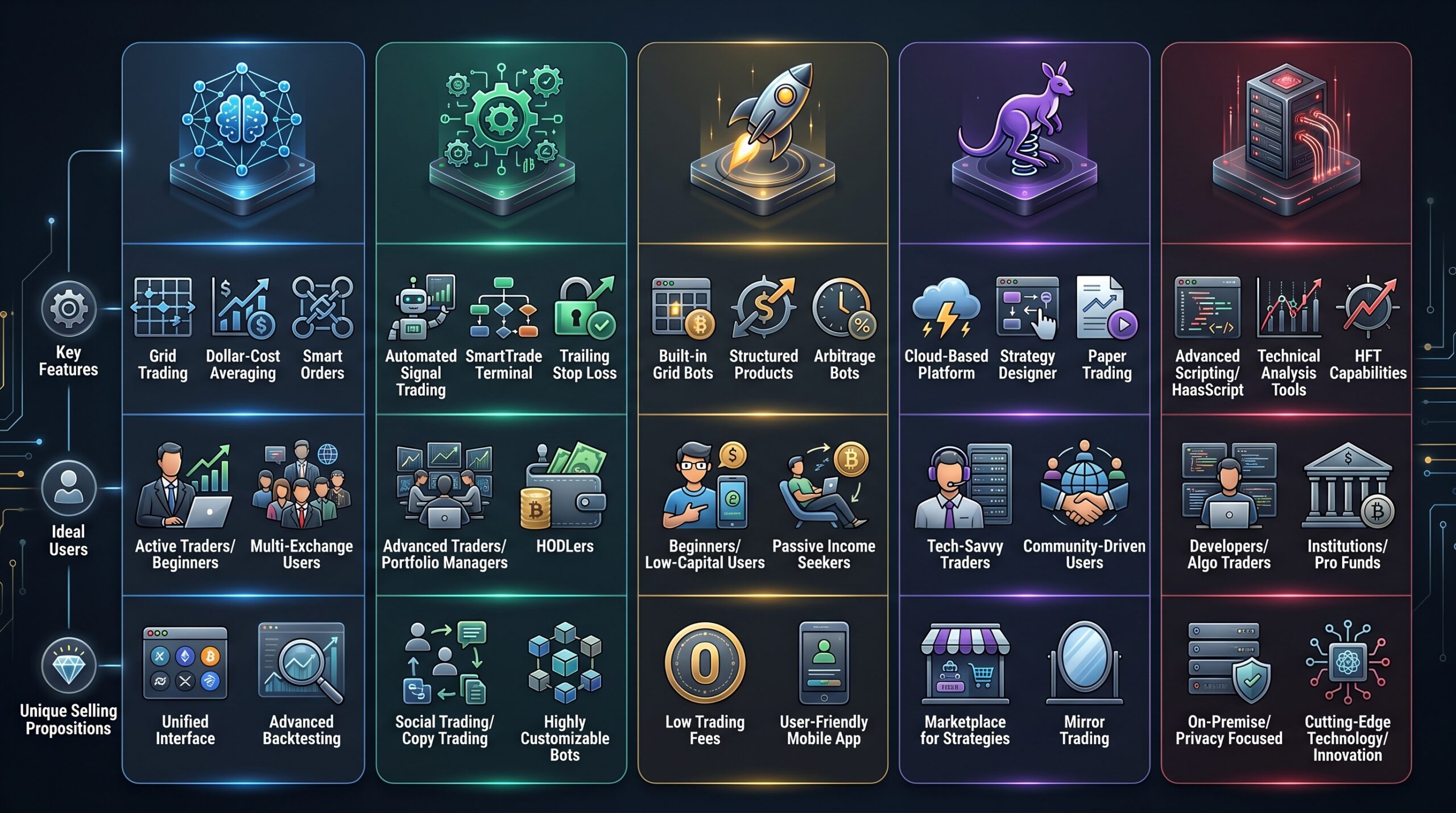
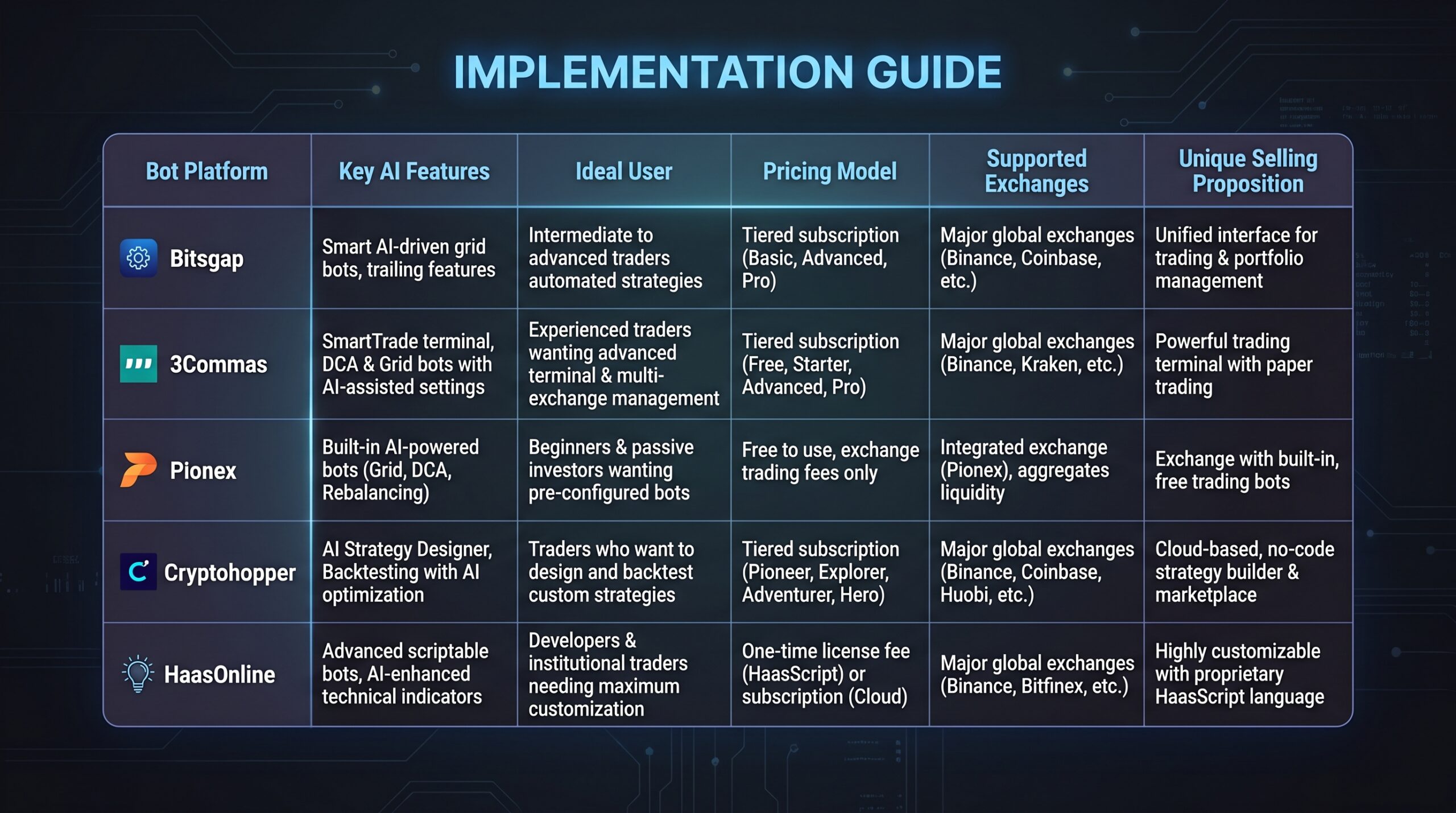
AI Trading Bot Feature Comparison Table 2026
Choosing the right AI trading bot requires a clear understanding of what each platform offers. This comparison table highlights the distinct features, ideal user profiles, pricing models, and unique selling propositions of the top AI crypto trading bots available in 2026, helping you make an informed decision based on your specific trading needs and experience level. For those looking into more specialized trading environments, like grid trading on Hyperliquid, understanding these distinctions is even more crucial.
AI vs. Manual vs. Traditional Bots: Why AI Leads in 2026
In the dynamic world of cryptocurrency trading, the evolution from manual execution to traditional rule-based bots, and now to advanced AI-driven systems, marks a significant leap in efficiency and potential profitability. By 2026, AI trading bots have definitively emerged as the leading method, primarily due to their unparalleled capacity for real-time data processing and adaptive algorithm deployment.
| Feature | AI Trading Bots | Manual Trading | Traditional Rule-Based Bots |
|---|---|---|---|
| Speed | Milliseconds execution, 24/7 | Seconds to minutes, human-dependent | Seconds, but limited by preset rules |
| Adaptability | Learns and adjusts strategies in real-time | High flexibility but slow | Static rules, no learning |
| Emotion control | No emotional bias | Prone to fear/greed | No emotion, but inflexible |
| Data processing | Analyzes vast datasets (news, social, technical) | Limited to human capacity | Basic technical indicators only |
| Profit potential | High with optimized strategies | Variable, skill-dependent | Moderate, depends on rule accuracy |
| Time requirement | Minimal after setup | High, constant monitoring | Moderate, requires rule updates |
AI bots significantly outperform both manual trading and traditional rule-based bots by leveraging real-time data streams and highly adaptive algorithms. For instance, consider a major market event like the flash crypto crash in May 2025. During this period, AI bots equipped with sophisticated sentiment analysis capabilities were able to detect the shift in market mood and proactively exit positions well before many manual traders could even react. This swift, emotionless response resulted in vastly reduced losses—up to 40% less severe compared to portfolios managed by static rule-based bots.
This decisive advantage of AI lies in its ability to continuously learn and adjust strategies. Unlike traditional bots that remain bound by their predefined parameters, AI bots utilize reinforcement learning to evolve. They identify emerging patterns and anomalies in data—including social media chatter, mainstream news, and subtle shifts in order book dynamics—which traditional bots, limited to basic technical indicators, would entirely miss. This continuous learning cycle means AI bots are not just faster, but also smarter and more resilient in unpredictable market conditions. Their 24/7 operational capability ensures that no opportunity is missed, whether during peak trading hours or the quietest periods, further solidifying their dominance in the 2026 crypto trading landscape.
Why AI Leads in Crypto Trading: Key Advantages
- Speed & Efficiency: Millisecond execution, 24/7 operation without human fatigue.
- Dynamic Adaptability: Real-time learning and strategy adjustments based on live market data.
- Emotionless Decisions: Eliminates human biases like fear and greed, leading to rational trades.
- Advanced Data Processing: Analyzes vast datasets from diverse sources (news, social media, technical).
- Higher Profit Potential: Optimized strategies and rapid execution capitalize on fleeting opportunities.
- Reduced Time Commitment: Automates monitoring and execution after initial setup.
How to Choose the Right AI Crypto Trading Bot
Selecting the best AI crypto trading bot is a critical decision that should be aligned with your individual experience level, financial budget, and specific trading objectives. The market offers a diverse range of solutions, each tailored to different user profiles and needs. Thoughtful consideration of these factors will lead you to a bot that genuinely enhances your trading strategy and potential for success.
For newcomers to crypto trading and automated systems, prioritizing platforms with user-friendly interfaces and extensive educational resources is paramount. Platforms like Pionex and 3Commas are particularly well-suited for beginners, providing intuitive setup processes, comprehensive guides, and supportive communities that help flatten the learning curve. These platforms often simplify complex trading concepts, allowing new users to gain confidence while minimizing initial risks.
Intermediate traders, who possess a foundational understanding of market dynamics and trading strategies, will benefit from bots that offer more advanced features. This includes sophisticated backtesting capabilities, which allow for the simulation of strategies against historical data, and granular strategy customization options. Bitsgap and Cryptohopper are excellent choices in this category, providing the tools necessary to refine and personalize trading approaches to a higher degree. Such features enable intermediate users to explore more complex tactics and optimize their bot’s performance with greater control. Meanwhile, alternatives to Zapier for developers may offer similar granular control over automation workflows, reinforcing the need for customizability in advanced tools.
Conversely, advanced users who require high-frequency trading capabilities or the ability to implement highly custom AI models should look towards specialized platforms. HaasOnline, for example, caters to this segment by offering robust computational power and unparalleled flexibility for complex algorithmic strategies. These platforms are designed for traders who demand the utmost in performance and customization, often involving direct integration with sophisticated quantitative models and high-speed execution environments.
Beyond user experience and feature sets, several practical considerations are equally important. Always evaluate the list of supported exchanges to ensure seamless integration with your preferred trading platforms, such as Binance or Kraken. Pricing transparency is another crucial factor; some bots operate on a monthly subscription model, while others deduct a percentage from your profits. Understanding these fee structures is vital for managing your costs effectively. Furthermore, security must be a top priority. Opt for bots that implement stringent security measures, including robust API key encryption and, crucially, do not request withdrawal permissions from your exchange accounts, thereby safeguarding your funds.
A recommended approach is to begin by testing any prospective bot with a small amount of capital. Most reputable platforms offer demo modes or paper trading environments, such as Cryptohopper’s practice environment, which allows you to simulate strategies risk-free using virtual funds. This hands-on testing phase is invaluable for understanding the bot’s behavior and performance without financial exposure. Additionally, reviewing community feedback on platforms like Reddit or Discord can provide authentic insights into a bot’s reliability, customer support, and real-world performance, offering a peer perspective that can inform your final decision.
Setting Up Your First AI Trading Bot: Step-by-Step
Deploying your first AI crypto trading bot may seem daunting, but by following a structured, step-by-step process, you can get started efficiently and securely. This guide outlines the essential stages from selecting a platform to optimizing your bot’s performance, ensuring a smooth initiation into automated trading.
1. Choose a Platform
Your initial step is to select a reputable AI trading bot platform. Options like Bitsgap or 3Commas are excellent starting points due to their user-friendly interfaces and comprehensive features. Take time to research reviews, compare features, and consider your trading goals and experience level when making this choice. Once decided, proceed to sign up for an account on your chosen platform.
2. Connect Exchange
After selecting your platform, you need to link it to your cryptocurrency exchange account. This is typically done by generating API keys from your exchange (e.g., Binance, Kraken). When generating these keys, it is crucial to enable trade permissions, allowing the bot to execute orders on your behalf. However, for enhanced security, explicitly disable withdrawal permissions. This ensures that even if your bot’s API keys were compromised, your funds could not be transferred out of your exchange account. This is a critical security best practice.
3. Select Strategy
The next step involves selecting an AI trading strategy that aligns with your market outlook and risk tolerance. Common AI-powered strategies include grid trading, which profits from market volatility by placing a series of buy and sell orders within a predefined range, and DCA (Dollar-Cost Averaging), which involves buying fixed amounts of an asset at regular intervals to reduce the impact of price fluctuations. Within your chosen platform, you will configure specific parameters such for your selected strategy; this might include the total investment amount, risk level, specific trading pairs (e.g., BTC/USDT), and any technical indicators the bot should prioritize.
4. Backtest
Before deploying your bot with real capital, always utilize the platform’s backtesting feature. Backtesting involves simulating your chosen strategy against historical market data to gauge its potential performance. Analyze the results to understand how the strategy would have performed in past market conditions, identify potential weaknesses, and make necessary adjustments to your settings. This iterative process of backtesting and refining is vital for optimizing your bot’s configuration and increasing its likelihood of success in live trading. For advanced users working with complex automation structures, insights from n8n alternatives for coding workflows can be useful for developing more robust testing environments.
5. Deploy
Once you are confident with your backtested strategy, you can deploy your bot. It is highly recommended to start with a minimal amount of funds initially. This approach allows you to observe the bot’s real-time performance in live market conditions without exposing a significant portion of your capital to unforeseen issues. Closely monitor the bot’s activity for the first 48 hours, ensuring it operates as expected and adheres to your configured parameters. This initial observation period is crucial for catching any immediate errors or misconfigurations.
6. Optimize
Bot deployment is not a ‘set and forget’ process. Continuous optimization is key to long-term success. Regularly review the bot’s performance logs and analytics provided by the platform. These insights will highlight areas for improvement. Based on this data, you can tweak settings, adjust parameters, or even switch strategies if market conditions change significantly. For example, if you are running a Bitsgap GRID bot, you might adjust the upper and lower price limits or the number of grids based on observed market volatility. This iterative optimization ensures your bot remains adaptive and effective in the evolving crypto market.
Advanced AI Trading Strategies for 2026
As AI crypto trading bots continue to evolve, they enable increasingly sophisticated strategies that leverage their speed, data processing capabilities, and adaptive learning. In 2026, advanced traders can deploy a range of AI-powered tactics to exploit market inefficiencies and maximize returns. These strategies often require specialized platforms and a deep understanding of market mechanics.
Arbitrage Trading
AI bots excel at arbitrage trading by identifying and exploiting minuscule price discrepancies across multiple cryptocurrency exchanges. For instance, an AI could instantaneously detect that Bitcoin is trading at $60,000 on Coinbase while simultaneously being offered at $60,050 on Binance. The bot would then execute a rapid buy order on Coinbase and an immediate sell order on Binance, profiting from the $50 difference per Bitcoin before the disparity can normalize. This strategy demands extremely low-latency connections and high execution speed, as these windows of opportunity often close in fractions of a second.
Sentiment Analysis
Leveraging natural language processing (NLP) models, AI bots can perform advanced sentiment analysis by continuously scanning a vast array of textual data sources. This includes social media platforms like Twitter, community forums such as Reddit, and a wide spectrum of news sites. The goal is to gauge the prevailing market mood towards specific cryptocurrencies or the overall market. A sudden surge in positive sentiment for a particular coin, detected by the AI, could trigger a proactive buy order, anticipating a subsequent price increase. Conversely, a rapid spike in negative sentiment might prompt the bot to sell or short an asset.
Market Making
Market making is a strategy where bots simultaneously place both buy and sell orders for an asset, aiming to profit from the bid-ask spread—the difference between the highest price a buyer is willing to pay and the lowest price a seller is willing to accept. High-frequency AI variants of market makers are designed to update these orders in microseconds, continuously adjusting to market depth and incoming order flow. This strategy requires significant capital and robust infrastructure to handle the constant flow of orders and execute them with minimal latency, typically yielding small profits per trade but accumulating substantial returns due to volume.
Portfolio Rebalancing
AI-driven portfolio rebalancing bots continuously monitor your asset allocation and adjust it based on predefined targets or dynamic market conditions. For example, if your portfolio is configured to maintain a 50% Bitcoin and 50% Ethereum allocation, and Ethereum significantly outperforms Bitcoin, causing its share to rise to 60%, the AI bot might automatically sell a portion of your ETH and buy BTC to restore the desired balance. This strategy helps manage risk, keeps your portfolio aligned with your long-term investment goals, and can be configured to optimize for various factors such as volatility, correlation, or even specific yield opportunities. The integration of such functionalities into financial planning mirrors how OpenHands Software Agent SDK aims to create production-ready AI development for diverse applications.
Implementing these advanced strategies typically requires not only sophisticated AI bots but also infrastructure that supports low-latency connections and high-frequency data feeds. Platforms like HaasOnline are specifically designed to offer the specialized scripts and computational power required to execute these complex and demanding trading approaches effectively.
Risks and How to Mitigate Them
While AI crypto trading bots offer significant advantages, they are not without risks. Successful deployment requires a keen awareness of these potential pitfalls and proactive implementation of mitigation strategies. Ignoring these risks can lead to substantial financial losses, as demonstrated by past incidents.
Common Risks
One primary concern is technical failures. Bugs, software glitches, or system downtimes can cause bots to behave erratically, execute incorrect trades, or fail to respond to critical market shifts. For example, a widespread incident in March 2026 saw a bug in a popular trading bot platform leading to numerous erroneous orders during a flash crash, amplifying losses for affected users.
Market volatility is an inherent risk in cryptocurrency trading, and even AI bots can struggle in extreme conditions. Sudden and unpredictable market movements, often influenced by macroeconomic news or regulatory announcements, can overwhelm a bot’s predefined parameters or even its adaptive learning capabilities, leading to unexpected losses.
Security vulnerabilities pose another critical threat. Bots operate by interacting with exchange APIs, making them targets for cyberattacks. Phishing attempts, malware, or compromised API keys can give malicious actors unauthorized access to your trading account, potentially leading to theft of funds or unauthorized trades.
Mitigation Strategies
To safeguard your investment and minimize risks, consider the following best practices:
- Use API Keys with Limited Permissions: When connecting your bot to an exchange, always generate API keys that grant only the necessary trading permissions. Crucially, disable any withdrawal permissions. This ensures that even if your API keys are compromised, an attacker cannot transfer your funds out of your account.
- Start with Small Amounts: When deploying a new bot or strategy, begin by allocating only a minimal portion of your capital. This allows you to test the bot’s reliability and performance in live market conditions without exposing significant funds. Gradually increase your investment as you gain confidence in the bot’s consistent and predictable operation.
- Set Strict Stop-Loss Orders: Incorporate stringent stop-loss orders into your bot’s strategy to limit potential downside. A stop-loss automatically closes a position if an asset’s price falls below a predetermined level, preventing further losses. This is a fundamental risk management tool that should not be overlooked.
- Choose Audited Platforms: Opt for AI bot platforms that have a proven track record of security and have undergone independent security audits. Platforms with strong encryption, two-factor authentication (2FA), and a history of transparent incident management are generally more reliable.
- Avoid “Set and Forget”: While bots automate trading, they require continuous oversight. Regularly monitor your bot’s performance, review its trading logs, and stay informed about market news and any potential platform updates. Market conditions change, and a bot that performs well today may need adjustments tomorrow. A weekly review is a good baseline.
Finally, it’s important to recognize regulatory risks. The legal landscape for automated trading and cryptocurrencies is still evolving. Some jurisdictions may impose restrictions or require specific compliance measures for operating trading bots. Always ensure your operations comply with local laws and regulations to avoid legal repercussions.
Case Study: 300% ROI Using AI Bots in 2025 Bull Market
The effectiveness of AI crypto trading bots in capitalizing on bullish market conditions can be significantly demonstrated through real-world examples. During the robust bull run of 2025, one particular trader achieved remarkable success by strategically deploying a 3Commas AI bot, illustrating the power of automated, intelligent trading.
This trader configured a Dollar-Cost Averaging (DCA) bot specifically for Ethereum (ETH), committing to a consistent daily investment of $100. The core intelligence of the bot lay in its AI algorithms, which were designed to dynamically adjust buy points. Specifically, the AI utilized key technical indicators such as the Relative Strength Index (RSI) and various moving averages to identify optimal entry points, ensuring that ETH was accumulated at potentially undervalued moments within the daily cycle.
Over a span of six months, the 3Commas AI bot successfully accumulated Ethereum at an impressive average price of $3,200 per ETH. In stark contrast, a manual trading approach attempting to achieve similar accumulation during the same period would likely have resulted in an average purchase price closer to $3,500. This $300 difference per ETH underscores the AI’s superior precision in timing market entries and mitigating the impact of minor market fluctuations.
When the trader decided to liquidate their accumulated Ethereum, the AI bot executed sell orders at an average price of $4,800. This strategic accumulation and timely liquidation resulted in a substantial 300% Return on Investment (ROI) over the six-month period. To put this into perspective, had the trader relied solely on manual execution, their ROI would have been closer to 200%. The AI’s ability to consistently execute trades based on data-driven insights, rather than succumbing to emotional biases like fear or greed during market corrections, was a critical factor in achieving this significantly higher profitability. This case study serves as a powerful testament to the potential for AI bots to enhance trading outcomes, especially in dynamic and volatile markets like cryptocurrency.
Future Trends in AI Crypto Trading
The landscape of AI crypto trading is poised for dynamic evolution beyond 2026, driven by technological advancements and shifting regulatory environments. Several key trends are expected to redefine how automated trading operates, integrating new functionalities and facing new challenges.
By 2027, a significant trend will be the deeper integration of AI bots with Decentralized Finance (DeFi) protocols. This will enable bots to participate autonomously in activities like yield farming, where they can seek out and automatically allocate assets to optimal liquidity pools or lending platforms for maximum returns. Cross-chain arbitrage, which currently faces technical hurdles due to blockchain interoperability issues, is expected to become more common and efficient. Improvements in cross-chain communication and atomic swaps will allow AI bots to exploit price discrepancies across different blockchain networks with greater speed and reliability.
While still largely experimental, the emergence of quantum computing could revolutionize AI analysis within trading. The exponential processing power of quantum algorithms might significantly speed up complex data analysis, enabling bots to process colossal datasets and execute strategies with unprecedented speed and accuracy. However, this remains a long-term prospect, with practical applications still several years away from mainstream adoption.
The regulatory environment will also play a crucial role in shaping the future of AI crypto trading. We anticipate an increase in global regulation as authorities catch up to the rapid pace of innovation. Frameworks like the European Union’s Markets in Crypto-Assets (MiCA) regulation already mandate greater transparency for automated trading tools and service providers. This trend will likely expand, leading to stricter compliance requirements, licensing, and oversight for AI bot platforms. Regulators will increasingly focus on ensuring market fairness and consumer protection.
Furthermore, the ethical implications of AI in finance will come to the forefront. There will be an increased focus on AI ethics, particularly concerning the potential for AI bots to contribute to or even cause market manipulation. Developers and regulators will work towards establishing guidelines and safeguards to ensure that AI-driven trading systems operate responsibly, preventing scenarios where algorithms could collude or artificially inflate/deflate asset prices. This ongoing development will challenge AI developers to create more robust and transparent models that can withstand scrutiny and maintain market integrity.
Key Takeaways: AI Crypto Trading Bots
- Advanced Automation: AI bots use machine learning, NLP, and reinforcement learning for real-time analysis and autonomous execution.
- Leading Platforms: Bitsgap, 3Commas, and Pionex are top choices, offering diverse features for all trader levels.
- Superior Performance: AI bots surpass manual and traditional rule-based trading in speed, adaptability, and emotion control.
- Selection Criteria: Choose bots based on experience, budget, goals, supported exchanges, and security features.
- Risk Mitigation: Use limited API permissions, start small, set stop-losses, and continuously monitor performance.
- Future Outlook: Expect integration with DeFi, enhanced cross-chain arbitrage, and increased regulatory oversight.
FAQ
What is the most profitable AI crypto trading bot?
While profitability varies with market conditions and user configuration, Bitsgap and 3Commas are consistently ranked among the most profitable AI crypto trading bots. Their advanced AI strategies and high reliability allow for optimized entry and exit points, contributing to significant returns under favorable conditions.
Are AI trading bots legal?
Yes, AI trading bots are legal in most countries. However, regulations can vary significantly depending on the jurisdiction. Major economic blocs like the EU, US, and UK permit their use, often with specific compliance and transparency requirements for platforms and users. Always verify local laws and regulatory guidelines in your region.
How much do AI crypto trading bots cost?
The cost of AI crypto trading bots ranges widely. Some platforms, like Pionex, offer free built-in bots, charging only minimal trading fees. Other popular bots, such as Bitsgap and 3Commas, typically have subscription models ranging from $29 to $99 per month, with advanced platforms potentially costing more or charging a percentage fee on profits.
Can AI trading bots guarantee profits?
No, AI trading bots cannot guarantee profits. Like all trading tools, they operate within inherently volatile markets. While they significantly mitigate risks by removing emotional bias, improving efficiency, and optimizing trade execution, the unpredictable nature of cryptocurrency markets means that losses are always possible. They are tools to enhance efficiency and potential, not certainty.
What’s the minimum investment for AI trading bots?
The minimum investment required for AI trading bots to be effective generally ranges from $100 to $500. While some platforms may allow smaller amounts, this range provides sufficient capital for diversification and to cover trading fees without limiting the bot’s ability to execute its strategy efficiently. It’s always advisable to start with a smaller amount and scale up gradually.