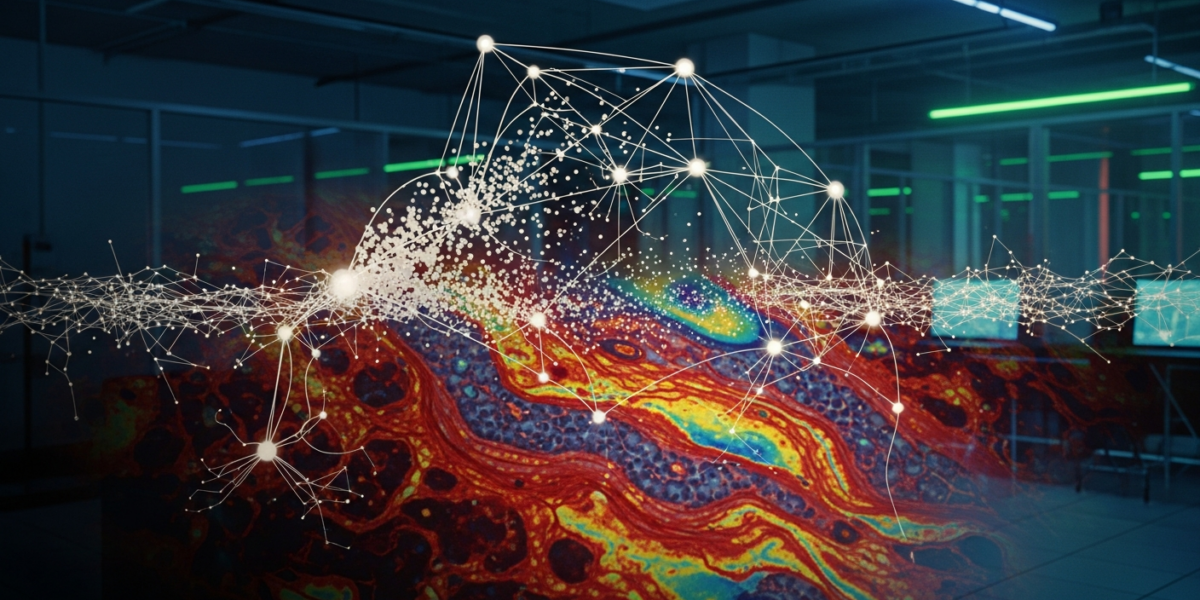
Deep learning models, effective in RGB tasks, are failing in scientific imaging like infrared pathology due to prior-bias mismatch. Operators must develop modality-specific AI.
Generic deep learning models, while highly successful in human-centric RGB visual tasks, are demonstrating critical failures when naively applied to scientific imaging modalities such as infrared (IR) pathology. This underperformance stems from a fundamental “prior-bias mismatch” where the models’ inherent simplicity bias interacts poorly with the information-rich, quantitative nature of scientific data, leading to one-dimensional predictions and underutilized representational capacity. This issue persists even with state-of-the-art robustification strategies designed for RGB imagery, necessitating a shift towards modality-specific AI development for scientific applications.
What changed
A new arXiv paper, “Anatomy of a failure: When, how, and why deep vision fails in scientific domains,” reveals a significant limitation of current deep learning (DL) frameworks: their unexpected and critical failures when applied to scientific imaging. Historically, deep learning has achieved remarkable success in processing everyday RGB images for perceptual tasks, leading to its widespread adoption across various domains. The prevailing assumption has been that these models would generalize effectively to other visual data, including scientific images.
The paper challenges this assumption by demonstrating that DL models, despite their ubiquity and success in consumer applications, can paradoxically underperform when presented with scientific data that is quantitatively superior to standard RGB. Specifically, the researchers compared DL performance on RGB images of stained tissue with infrared (IR) images of the same tissue. IR data, by its nature, encodes precise physicochemical properties across potentially thousands of channels, offering a significant informational advantage over RGB. However, models trained on this information-rich IR data performed worse, collapsing to one-dimensional predictions and failing to leverage the data’s full representational capacity.
This finding represents a critical shift from the common narrative of DL’s universal applicability. It highlights that the “simplicity bias” inherent in many DL architectures, which works well for the relatively constrained and qualitative nature of human visual perception, actively hinders performance when confronted with the complex, high-dimensional, and quantitative nature of scientific data. This problem is not merely a matter of insufficient data or training; it’s a fundamental mismatch between the model’s inductive biases and the data’s inherent priors, a problem that even robustification strategies designed for RGB imagery fail to address.
Why it matters for operators
For operators in scientific research, medical diagnostics, and industrial imaging, this research is a stark warning against the naive application of off-the-shelf deep learning solutions. The paper underscores that simply porting models validated on consumer photography to scientific modalities like infrared imaging is not just suboptimal; it can lead to “catastrophic DL failure.” This means operators building AI-powered tools for scientific discovery or clinical decision support cannot rely on the implicit assumption that “more data and bigger models” will solve all problems. The core issue isn’t computational scale but a fundamental epistemological mismatch: how the model “knows” and processes information is misaligned with the scientific data’s structure and meaning. This is akin to trying to read a complex scientific paper with only the vocabulary for everyday conversational English.
The FrontierWisdom perspective here is that this isn’t just an academic curiosity; it’s a call to action for specialized AI development. Operators need to move beyond generic deep learning frameworks and invest in understanding and developing modality-specific AI. This means collaborating closely with domain experts—biochemists, physicists, materials scientists—to embed scientific priors directly into model architectures or training methodologies. For instance, instead of relying on standard convolutional filters, perhaps operators need to design filters that explicitly respond to spectroscopic signatures or physical properties relevant to the scientific domain. This approach aligns with the scientific method, which emphasizes careful observation and hypothesis testing to identify and correct systematic errors, rather than simply scaling up a flawed approach. The implication is clear: the era of “one AI model fits all vision tasks” is over for serious scientific applications. Those who continue to push generic models into these complex domains risk building systems that are not only inaccurate but potentially unsafe, undermining the very advantages that advanced scientific modalities offer.
Risks and open questions
- Misinterpretation of “robustness”: The paper notes that state-of-the-art robustification strategies, primarily validated for RGB imagery, fail to address this prior-bias mismatch. This raises questions about the generalizability of current AI safety and robustness benchmarks to scientific domains. Operators relying on these benchmarks for scientific applications may have a false sense of security.
- Resource allocation: Developing modality-specific AI requires significant investment in specialized expertise (both AI and domain-specific) and potentially novel architectural research. This poses a challenge for smaller organizations or those with limited R&D budgets, who might be tempted to continue using generic solutions despite the risks.
- Defining “scientific priors”: A key challenge will be formally defining and encoding the “scientific priors” for various modalities into DL models. This is not a trivial task and will require deep collaboration between AI researchers and domain scientists, echoing the interdisciplinary nature of the scientific method.
- Generalization across scientific modalities: While the paper focuses on infrared imaging, it opens the question of how broadly this prior-bias mismatch applies to other scientific imaging types (e.g., cryo-electron microscopy, fMRI, hyperspectral imaging). Each modality may present its own unique failure modes that require specific investigation.
- Ethical implications of failure: In fields like pathology, AI failures can have direct patient impact. The paper raises “AI safety concerns” by highlighting how models can underperform despite informational advantages, leading to potentially missed diagnoses or erroneous scientific conclusions.