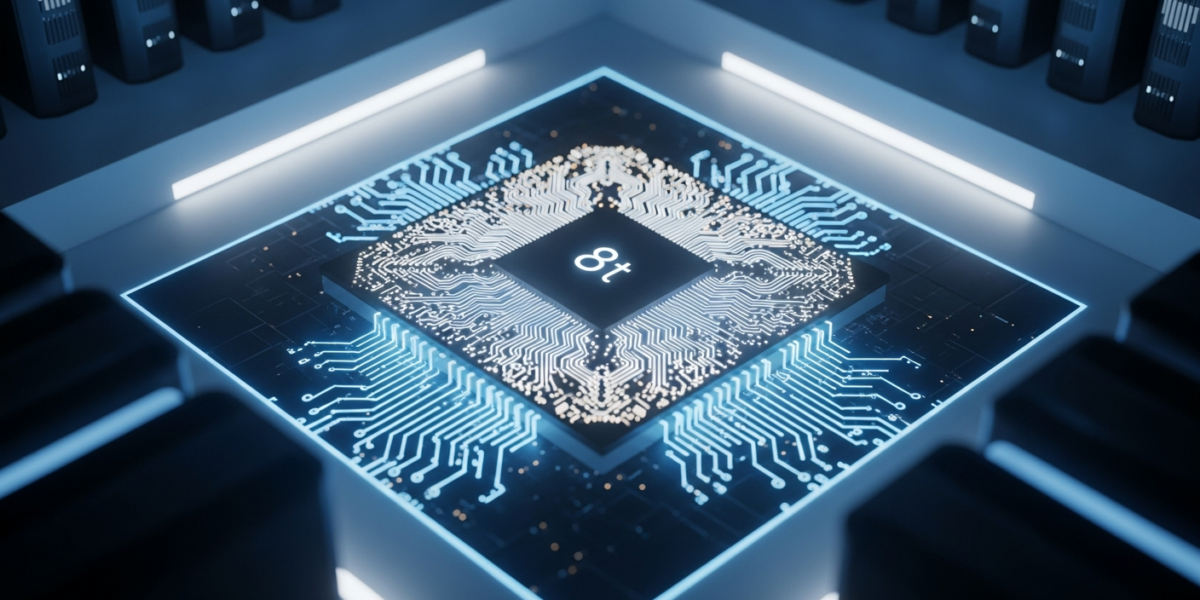
Google’s eighth-generation Tensor Processing Units, TPU 8t and TPU 8i, are specialized AI chips designed to meet the demands of agentic AI workloads. These TPUs enable AI models to reason, plan, and execute multi-step workflows, offering significant advancements in processing power and memory bandwidth for complex, autonomous AI tasks.
| Attribute | Detail |
|---|---|
| Released by | Google AI |
| Release date | Not yet disclosed. |
| What it is | Eighth-generation Tensor Processing Units (TPU 8t and TPU 8i) designed for AI agent workloads. |
| Who it is for | Developers and enterprises building and deploying complex AI models and autonomous agents. |
| Where to get it | Google Cloud |
| Price | Not yet disclosed. |
- Google introduced its eighth-generation TPUs, the TPU 8t and TPU 8i, for AI agent workloads.
- TPU 8t and 8i are designed for AI models that reason, plan, and execute multi-step workflows.
- The newest generation of TPUs can process 121 exaflops of compute power.
- TPU 8i features increased memory bandwidth for latency-sensitive inference workloads.
- TPU 8t utilizes the Virgo Network, offering up to 4x increased data center network bandwidth.
- Google’s TPU 8t and TPU 8i are specialized hardware for the “agentic era” of AI.
- These TPUs support AI agents that perform complex reasoning and multi-step tasks.
- The latest TPUs offer 121 exaflops of compute power and double the bandwidth of prior generations [1].
- TPU 8i is optimized for latency-sensitive inference with enhanced memory bandwidth [4].
- TPU 8t’s Virgo Network provides up to 4x increased data center network bandwidth [5].
- TPUs are designed to improve value and power consumption by focusing on AI computational demands [8].
What are Google TPU 8t and 8i
Google TPU 8t and 8i are the eighth generation of Tensor Processing Units, custom-designed chips for artificial intelligence workloads [2, 3]. These TPUs are specifically engineered to power increasingly demanding AI tasks, particularly those involving autonomous AI agents [3]. AI agents need to reason, plan, and execute multi-step workflows [3].
What is new vs the previous version
Google’s TPU 8t and 8i introduce significant advancements over previous generations, focusing on the needs of agentic AI [2, 3].
- Compute Power: The newest generation of TPUs can process 121 exaflops of compute power [1].
- Bandwidth: They offer double the bandwidth compared to previous generations [1].
- Agentic AI Focus: TPU 8t and 8i are designed for AI models that reason, execute multi-step workflows, and learn from actions [2].
- Memory Bandwidth (TPU 8i): TPU 8i is designed with more memory bandwidth for latency-sensitive inference workloads [4].
- Network Architecture (TPU 8t): TPU 8t introduces the Virgo Network, enabling up to 4x increased data center network bandwidth [5].
- Efficiency: The collapsed fabric architecture offers 4x the bandwidth of previous generations, eliminating “scaling tax” [6].
How do TPU 8t and 8i work
TPU 8t and 8i are designed to accelerate the complex mathematical operations required by AI models [1].
- Specialized Design: TPUs are engineered to improve value and power consumption by focusing on AI computational demands [8].
- Agentic Workloads: They enable AI models to reason through problems and execute multi-step workflows [2].
- High Compute Power: The newest generation processes 121 exaflops of compute power [1].
- Increased Bandwidth: They feature double the bandwidth of previous generations to handle large data flows [1].
- Network Optimization (TPU 8t): The Virgo Network supports massive data requirements with up to 4x increased data center network bandwidth [5].
- Inference Optimization (TPU 8i): TPU 8i has more memory bandwidth to serve latency-sensitive inference workloads [4].
Benchmarks and evidence
| Metric | Value / Description | Source |
|---|---|---|
| Compute Power | 121 exaflops (newest generation) | [1] |
| Bandwidth | Double the bandwidth of previous generations | [1] |
| TPU 8t Data Center Network Bandwidth | Up to 4x increase over DCN for training (via Virgo Network) | [5] |
| Previous Generation (7th Gen Ironwood) Performance | 2 to 4 times faster and 30% lower cost for demanding workloads | [7] |
| TPU 8i Memory Bandwidth | Designed with more memory bandwidth for latency-sensitive inference | [4] |
Who should care
Builders
Builders developing autonomous AI agents will find TPU 8t and 8i crucial for complex, multi-step workflows [3]. These chips provide the necessary compute and memory for advanced AI model development [1, 4].
Enterprise
Enterprises deploying large-scale AI solutions, particularly those requiring agentic capabilities, will benefit from the performance and efficiency [2]. The increased bandwidth and compute power can accelerate business processes [1, 5].
End users
End users will experience more capable and responsive AI applications powered by these advanced TPUs. Autonomous agents can perform tasks on their behalf more effectively [3].
Investors
Investors should note Google’s continued investment in specialized AI hardware, positioning it competitively in the AI infrastructure market [2]. This could indicate future growth in Google Cloud’s AI offerings.
How to use TPU 8t and 8i today
TPU 8t and 8i are available through Google Cloud [7]. Users can access these powerful TPUs by configuring their AI workloads within the Google Cloud platform. Specific API calls or UI steps for provisioning these exact models are not yet disclosed.
TPU 8t and 8i vs competitors
Google’s TPUs are custom-designed for AI workloads, offering an alternative to general-purpose GPUs [8].
| Feature | Google TPU 8t/8i | NVIDIA GPUs (General Purpose) | Other AI Accelerators (e.g., custom ASICs) |
|---|---|---|---|
| Primary Focus | AI-specific computational demands, agentic workloads [8, 2] | General-purpose parallel processing, graphics, and AI | Highly specialized for specific AI tasks (e.g., inference, training) |
| Compute Power (Newest Gen) | 121 exaflops [1] | Not yet disclosed. | Not yet disclosed. |
| Bandwidth (Newest Gen) | Double previous generations [1] | Not yet disclosed. | Not yet disclosed. |
| Network Architecture | Virgo Network for TPU 8t (4x DCN bandwidth) [5] | Various interconnects (e.g., NVLink) | Proprietary interconnects |
| Memory Bandwidth (TPU 8i) | Enhanced for latency-sensitive inference [4] | High bandwidth memory (HBM) | Varies by design |
| Cost/Efficiency | Aims for improved value and power consumption [8] | Can be higher for pure AI workloads due to multi-purpose architecture | Potentially very efficient for narrow tasks, less flexible |
Risks, limits, and myths
- Vendor Lock-in: Relying heavily on Google’s custom hardware could lead to vendor lock-in within the Google Cloud ecosystem.
- Specialization Limits: While optimized for AI, TPUs might not be as versatile for non-AI computational tasks as general-purpose GPUs.
- Complexity of Agentic AI: The success of agentic AI depends on more than just hardware; model design and data quality are also critical.
- Myth: TPUs replace all other AI hardware: TPUs are a specialized solution, not a universal replacement for all AI acceleration needs.
FAQ
- What are Google TPU 8t and 8i?
- Google TPU 8t and 8i are the eighth generation of Google’s custom Tensor Processing Units, designed to power advanced AI workloads, especially autonomous AI agents [2, 3].
- What is “agentic AI”?
- Agentic AI refers to AI models that can reason through problems, execute multi-step workflows, and learn from their own actions in continuous loops [2].
- How powerful are the new TPUs?
- The newest generation of TPUs can process 121 exaflops of compute power [1].
- What is the main difference between TPU 8t and TPU 8i?
- TPU 8t is designed for training with enhanced network bandwidth via Virgo Network, while TPU 8i is optimized for latency-sensitive inference workloads with more memory bandwidth [4, 5].
- Are TPUs more efficient than GPUs for AI?
- TPUs are engineered to improve value and power consumption by focusing specifically on the computational demands of AI, eliminating operational overhead of multi-purpose architectures [8].
- When will TPU 8t and 8i be available?
- Not yet disclosed.
- Can I use TPU 8t and 8i outside of Google Cloud?
- Google TPUs are typically offered through Google Cloud services [7].
- What is the Virgo Network?
- The Virgo Network is a new networking architecture introduced with TPU 8t, enabling up to 4x increased data center network bandwidth for massive data requirements [5].
Glossary
- TPU (Tensor Processing Unit)
- A custom-designed application-specific integrated circuit (ASIC) developed by Google for accelerating machine learning workloads [8].
- Agentic AI
- Artificial intelligence systems capable of reasoning, planning, executing multi-step workflows, and learning autonomously [2, 3].
- Exaflops
- A measure of computer performance, equal to one quintillion (10^18) floating-point operations per second [1].
- Inference
- The process of using a trained machine learning model to make predictions or decisions on new data [4].
- Virgo Network
- A new networking architecture for TPU 8t designed to support massive data requirements with increased data center network bandwidth [5].
Sources
- Here’s how our TPUs power increasingly demanding AI workloads.
- Our eighth generation TPUs: two chips for the agentic era
- We’re launching two specialized TPUs for the agentic era.
- Google unveils new AI chips to rival Nvidia: Here is what they offer
- TPU 8t and TPU 8i technical deep dive | Google Cloud Blog
- AI infrastructure at Next ‘26 | Google Cloud Blog
- Google Introduces Its Eighth Generation of Custom Tensor Processor Unit | TechPowerUp
- Tensor Processing Units (TPUs) | Google Cloud